December Program Report: “The Silver Mines of Lavrion, An Incredible and Diverse Mineral Wealth from Ancient Greece to Modern Times,” Part 2,” by Fred Paraskevoudakis
Synopsis by Andy Thompson, MSDC Secretary (with generous edits from the presenter)
Professor Fred Paraskevoudakis’ presentation on December 3rd focused on the geology and minerals of several mines to the west of Lavrion’s ancient silver mine, as shown in the illustration below.
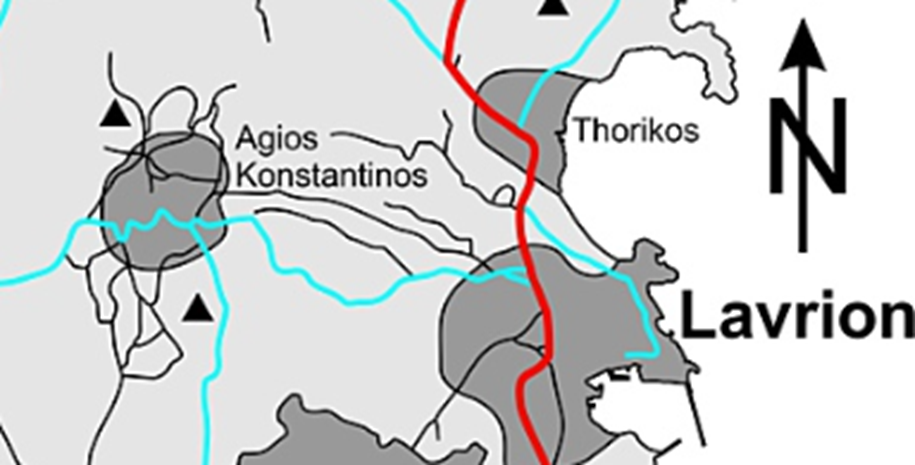
Fred’s October presentation focused on the ancient silver mine in the area of the coastal town of Thorikos. His December talk focused on the Jean Baptiste and Hilarion mines located near the town of Agios Konstantinos (Saint Constantine), west of the port towns of Thorikos. The map’s entire area is referred to as the Lavrion District. Many of its mines are interconnected.
For the benefit of anyone in the December audience who missed Part One in October, Fred gave a short review of the highlights of his earlier talk.
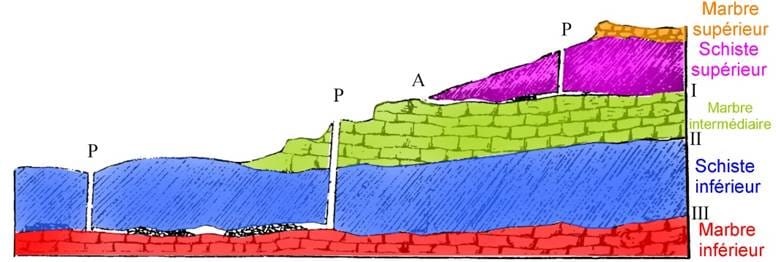
He did this by briefly describing the structural geology of Greece, formed by the collision of two tectonic plates, the African plate pushing north and subducting beneath the Eurasian plate. Those geologic events date to the early Miocene Epoch, 20 to 25 million years ago. Importantly, those events contributed to the development and movements of the three strata or layers in the wide and deep Lavrion District, as illustrated below.
Readers please note: Fred provided several slides of his underground mine tours. So the slides in this Program Report were taken from diverse sources and credited accordingly. Also, please note, variations in the spelling of Laurion are common in translations and so includes Lavrion. The Greek alphabet has an upsilon (“U”) but no “V”.
Fred reminded his audience that the development and movements of the above illustrated three layers provided the geological framework for the ancient Lavrion silver mines at Thorikos. The ancient Athenian government systemically excavated those early mines during the final five centuries BC. As Fred explained in his October presentation, the ancient Athenian government and, later, the entire Greek nation reaped the silver mines’ great financial benefits.
Those same geological dynamics were also responsible for the copper and silver-rich galena, a lead sulfide ore deposit. The galena was extensively extracted from the earliest mine near Thorikos and had multiple shafts for extraction of the silver-laden galena.
The mines in the western part of the Lavrion district, near Agios Konstantinos, had galena with valuable ores but less silver. Those mines were opened 2,000 years later, during the 1800 and 1900s AD. In the intervening two thousand years, including between the early centuries of the Roman empire and subsequent twelve centuries, for political reasons, little mining took place.
The geologic structure of the Lavrion mining area is unique and consists of three distinct strata, each containing a unique set of minerals in their respective contact zones. Fred described them, from top to bottom, as:
· First Contact Zone is within the upper limestones and contains significant quantities of lead, zinc, and silver sulfide minerals.
· Second Contact Zone is between the upper Kamariza marble and Kamariza schist and contains significant quantities of cerussite (lead carbonate) and smithsonite (zinc carbonate) ores.
· Third Contact Zone is situated between the lower Kamariza marble and Kamariza schist and contains significant quantities of cerussite and iron oxides.
Generally speaking, all the mining area throughout the entire Lavrion district
underwent the geological process of the African plate’s subduction beneath the
Eurasian plate. That process created large contact zones that filled with material and hydrothermal fluids generating the extensive ore deposits. Over the millions of years, those deposits underwent further alteration and chemical changes along with high temperatures, pressures, and then oxidation of the periphery of the ore beds within the contact zones. The oxidation zones produced the myriad of mineral combinations we see today. To date, the Lavrion mines have produced 678 different species and still counting.
This rich diversity produced more mineral varieties than any other place in the
world except for Namibia, Africa. These beautiful minerals of the Lavrion District, including macro and microminerals, are much sought after by today’s collectors.
Typical Mineral Deposits of the More Western Lavrion District Mines
Fred then introduced his MSDC audience to the minerals of the Jean Baptiste and Hilarion mines, the subject of his presentation on December 3rd.
Fred noted that the mineralization of the Lavrion district contained many metallic minerals, including sulfides and sulfoarsenides. He cited, in particular, the prevalence of galena, pyrite, arsenopyrite, chalcopyrite, sphalerite, and many others. He reminded his audience that it was the zinc/galena ore of the ancient silver mine that was the source of the silver which propelled the wealth and political stability of the Athenian Greek culture.
Below are photos of some of the minerals that Fred identified as prevalent in the Jean Baptiste and Hilarion mines, opened in 1870 and closed in 1977.
Galena
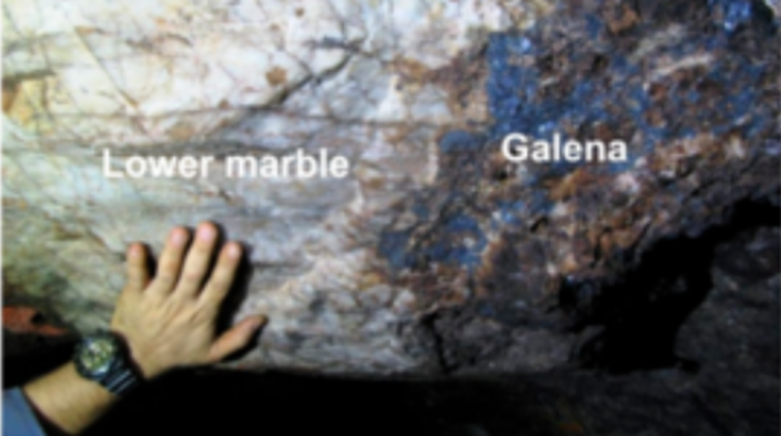
The photo of galena above, a lead sulfide, PbS2, is found in the lower marble strata, and is commonly found in the Jean Baptiste and Hilarion mines. Fred said it indicates a contact zone between two strata.
The galena mined in most other locations, is simply a lead sulfide. But the galena discovered in the ancient Lavrion mines 2,500 years ago was formed by a relatively unique geological process as explained above. It contained an unusual high content of silver and was mixed with zinc as well.
Given the low tech available to miners at the time, namely slave labor, the mine shafts remained necessarily close to the surface. Two thousand years later, the mines further west, such as the Jean Baptiste and Hilarion, used the technology of the 1800 and 1900 hundreds. So, they were able to harvest minerals from greater depths. Geologists found many minerals with complex chemical compositions, including the following.
Chalcopyrite
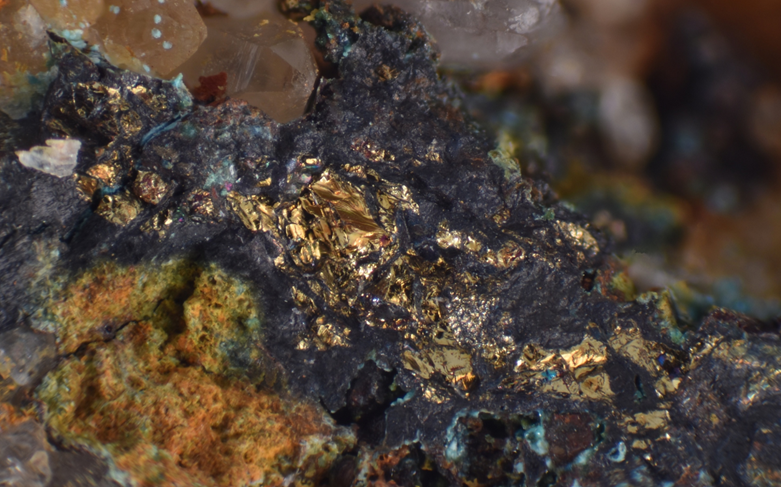
Fred said that many of the minerals of the Jean Baptiste mine have unique chemistries which makes it famous for producing unusual variations. Case in point is chalcopyrite, shown above. It has various inclusions such as calcium sulfide, CaS, alongside the more common calcium sulfate, CaSO4, gypsum, in its hydrated form. Fred also noted this mine’s complex chemistry results in an unusually high number of “Type Locality” minerals.
Smithsonite
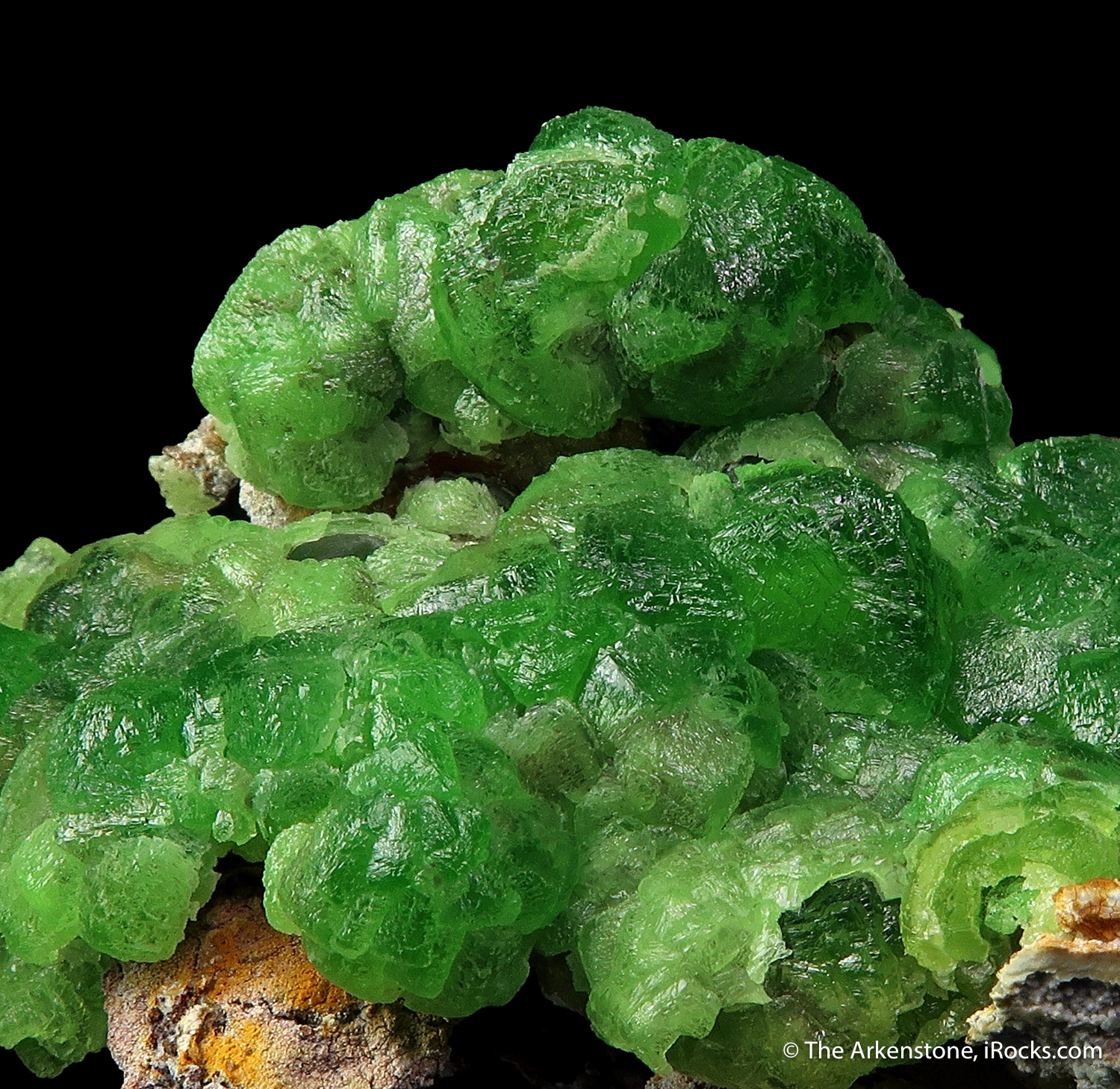
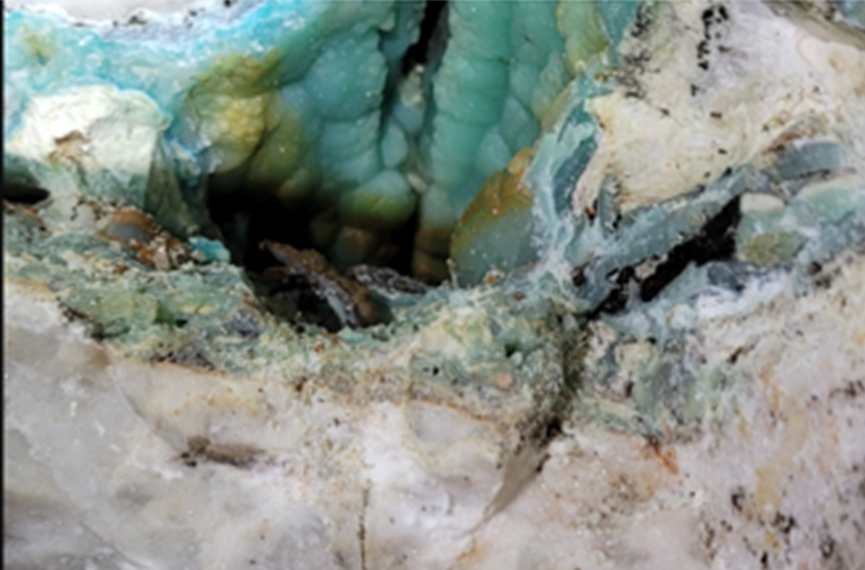
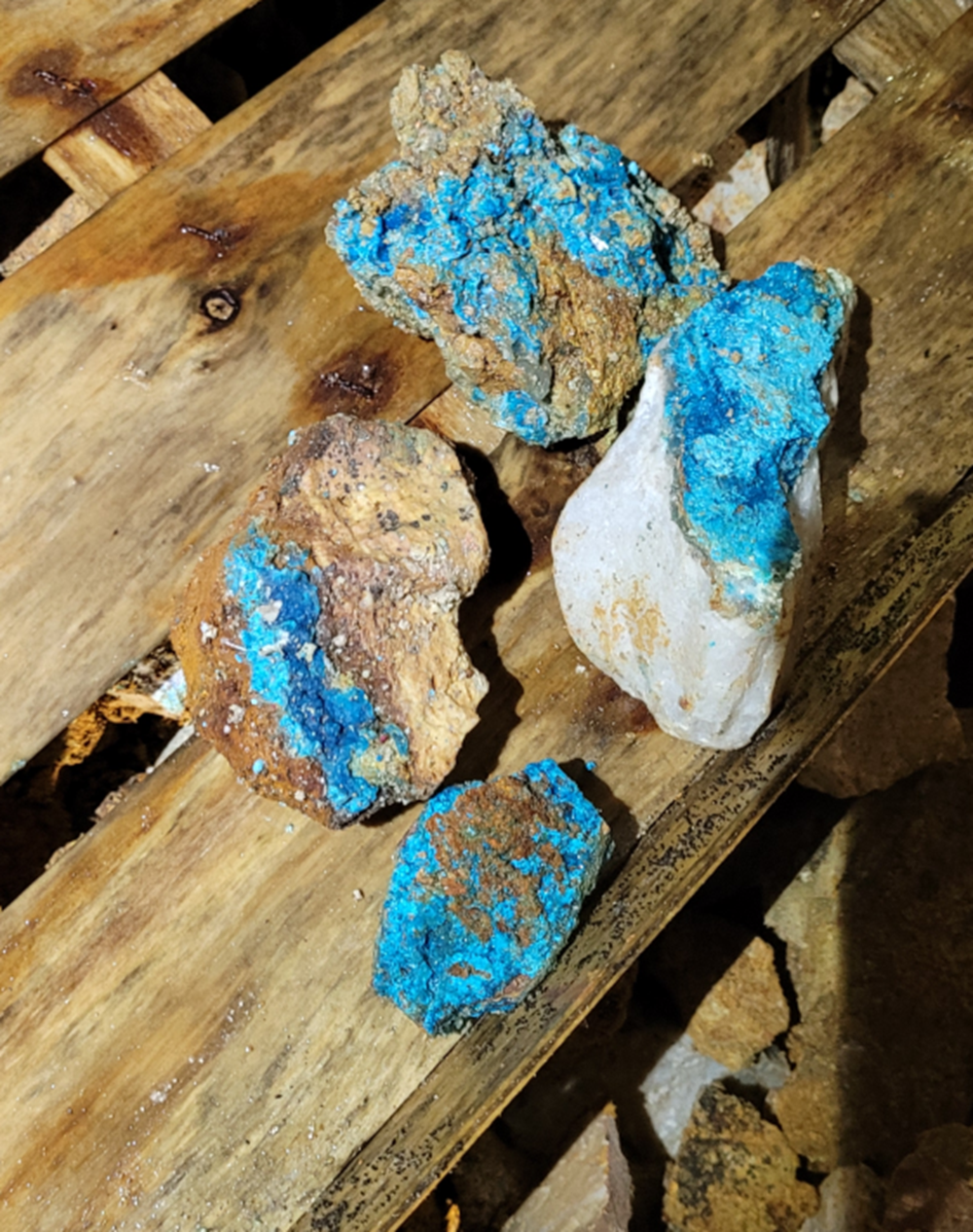
Smithsonite is a zinc carbonate mineral, often green as shown above. But its habit is typically botryoidal and rounded. In contrast, the chemistry of the Hilarion mine’s variety of smithsonite, shown below, often includes copper which gives those specimens the famous vibrant blue color evident in the upper left side. Fred provided the photo below.
Blue Smithsonite
Challenges that Mine Researchers Experience
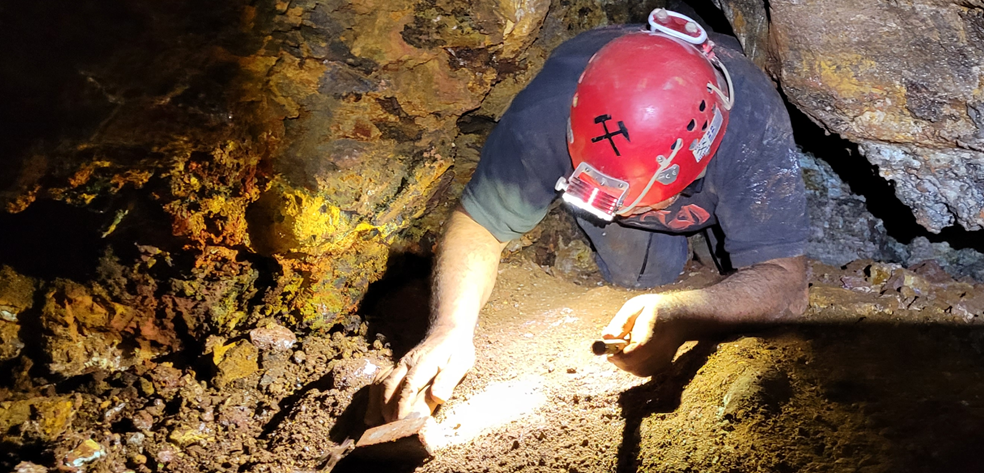
During Fred’s presentations, his videos showed his audience the many serious challenges he, Vasilis and mine researchers typically experience. The photo below shows Fred crawling on his stomach to get past a “Squeeze Through.” Remember, their equipment and any minerals they collect needs to pass through this narrow passage on their way back out of the tunnels.
Another challenge required the two researchers to take turns for a considerable time carefully hammering with a feather wedge and two chisels to safely extract the smithsonite specimens from their marble host rock.
Serpierite
Note that the Thorikos mine is on the eastern edge of the Lavrion district. Its ancient silver mine was mentioned in Fred's Part One presentation. The Jean Baptiste and Hilarion mines to the West, were the focus of his Part Two talk. All three of the mines illustrated and discussed here, are within the Lavrion district. The ancient silver mine featured in Part One abuts the Aegean Sea. The mine’s slag piles of rock contained micro vugs that, over the centuries and influenced by Aegean waters and chemistry, allowed the growth of unusual mineral crystals.
Illustration and Description of Selected Mine Locations
The Jean Baptiste & Hilarion mines are close to one another, north and south of the town of Agios Konstantinos. They, and the Serpieri mine, whose namesake, Fred mentioned, was an important Italian entrepreneur (1832-1897). Those mines are shown along the red line of the illustration below.
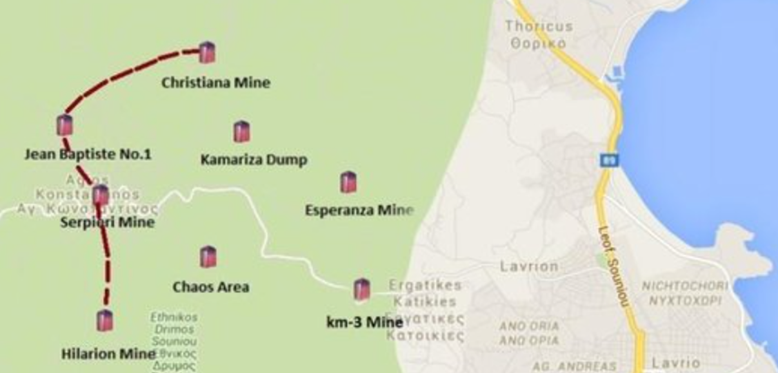
The above illustration shows the above-ground locations of five of the many mines Fred spoke about. The illustration below shows the below-ground relative depths of those same mines. The slanted red lines, Fred pointed out, are dikes, through which heavily mineralized waters flow upwards and solidify.
The view below will be helpful as you, the reader, try to imagine what Fred saw as he climbed through the narrow underground tunnels, avoiding dangerous pitfalls, and used his cell phone to capture how the minerals formed in the three main strata throughout the mines of the western part of the Lavrion District.
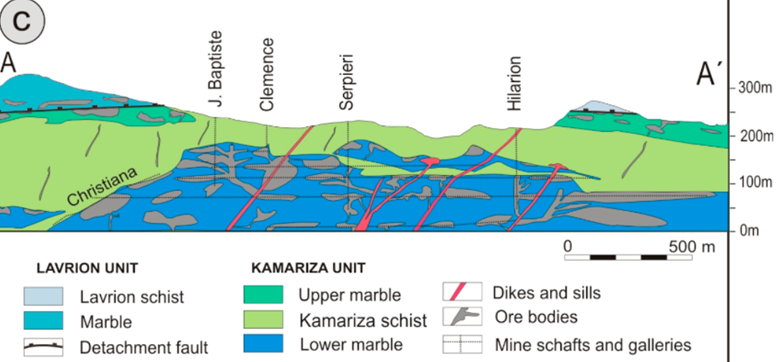

Fred pointed out that all these mines were physically interconnected. They were also connected in time, being developed during the late 1800s and worked into the 1900s. At least two of the mines were developed, initially by the same person, Mr. Serpieri (1832-1897), an Italian geologist who secured funding through a French bank to create the modern Lavrion mining district. Serpieri had as his first and middle names, Ioannis Baptista.
Those interested in seeing Fred’s videos would do themselves a favor to watch for any future presentation he may be making to other clubs or groups. MSDC will let you know if we learn of Fred giving any future presentations.
Key Take-away Messages Concerning Underground Mine Tours
Fred’s video clips of his visits through the mines made it easy to see why amateur mineral collectors should never enter defunct mines without a professional guide. Here are a few footnotes as takeaways concerning underground mine tours.
1) Underground field trips have physical challenges. This type of field trip in abandoned mines is no cake walk.
2) Getting to the highly mineralized strata can require physical stamina, and requires being alert for signs of new or old cave-ins where the holes in the paths could result in unwary visitors falling to lower levels of the mine.
3) Visitors going through the mines can also be suddenly surprised by finding large galleries, empty spaces, initially puzzling. Fred noted those empty spaces were what miners left behind after the workers extracted the valuable copper and zinc ores.
4) Those interested in history can discover traces left behind by the miners a century or two earlier. Fred showed discarded wooden boxes that once carried explosives, broken tools, carts, writing or torch marks on the walls, and small shafts for air flow or for dumping ore to lower levels where elevators once winched the ore to the surface.
5) Also, by paying attention to the geological formations, geologists can “read” how the mineral formations interacted with one another over thousands and millions of years. They can see the metamorphic results, the creating of diverse minerals characteristic of this part of Greece.
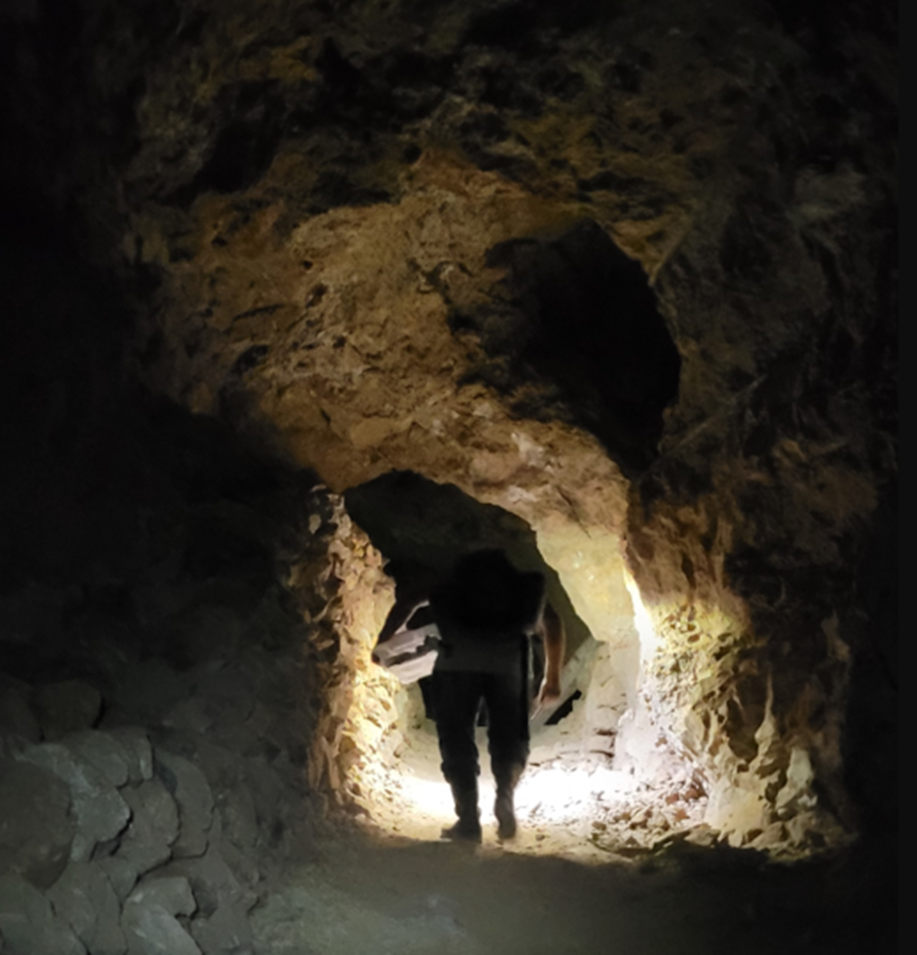
6) Fred’s cell phone videos captured deep in the Hilarion mine the results of miners who chiseled and built staircases, support walls and tracks for carts for transporting heavy ore.
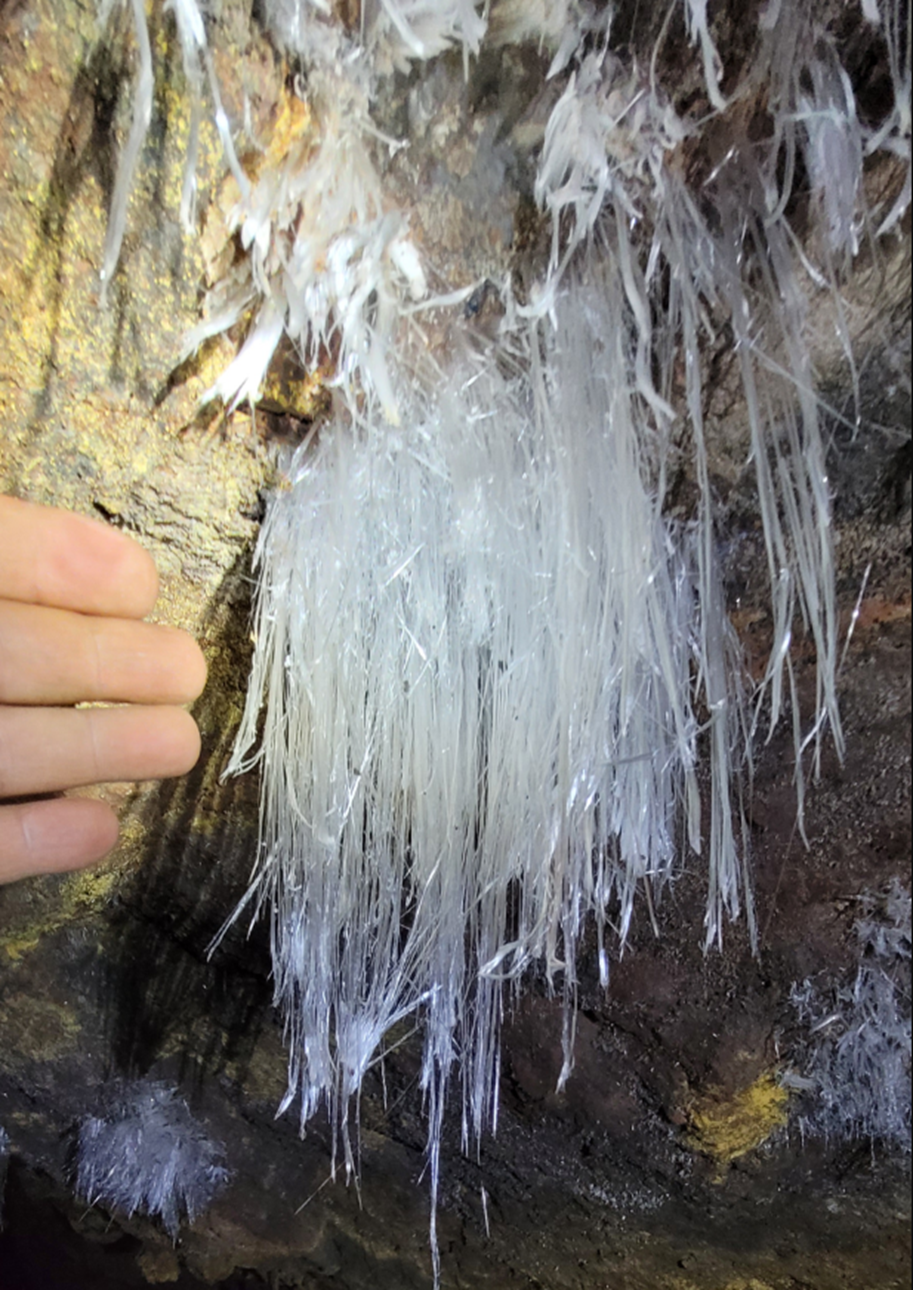
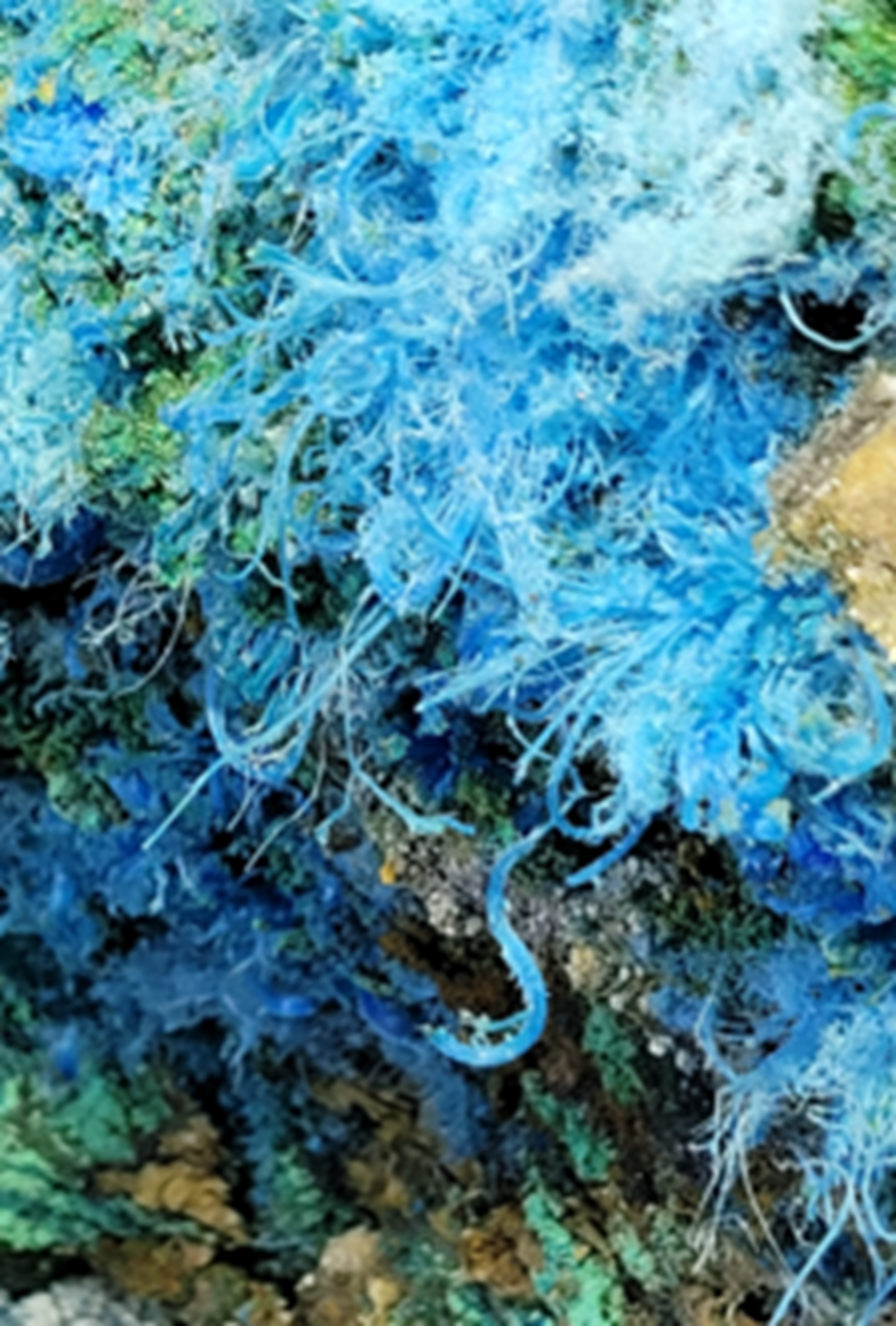
7) Best of all was discovering beautiful specimens in their natural setting and complexity, such as those found in the photos below.
Epsomite
Chalcanthite
Mineral Researcher Returning to the Surface
Conclusion
Throughout Fred’s two presentations in October and December, he showed perhaps hundreds of beautiful and interesting minerals first, in their natural settings deep within the mines, and then cleaned up for display by collectors. For many minerals, he explained their interesting geological context and mineralogy.
Having completed his story of the minerals of the Lavrion district’s mines, Fred then concluded his presentation by returning above ground to celebrate several ancient marvels of the ancient Greek culture, including the Parthenon in Athens, and, as shown below, the amphitheater of the city of Epidaurus and Temple of Poseidon.
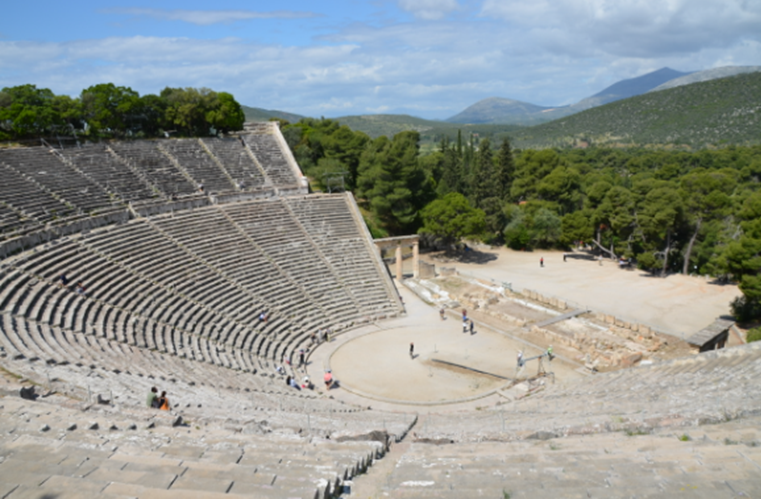
The above 4th century BC amphitheater was part of an ancient center for healing. Fred, who visited the area, said it was part of the sanctuary of Asklepios, the God of healing. It continues in use today for plays, with perfect symmetry and incredible acoustics. Fred said he could hear a person speaking on stage as he sat in the most distant seat in the top row. It holds 14,000 spectators and is a UNESCO World Heritage site. The city of Epidaurus is located about 90 miles (126 km) by car from the Lavrion mining district.
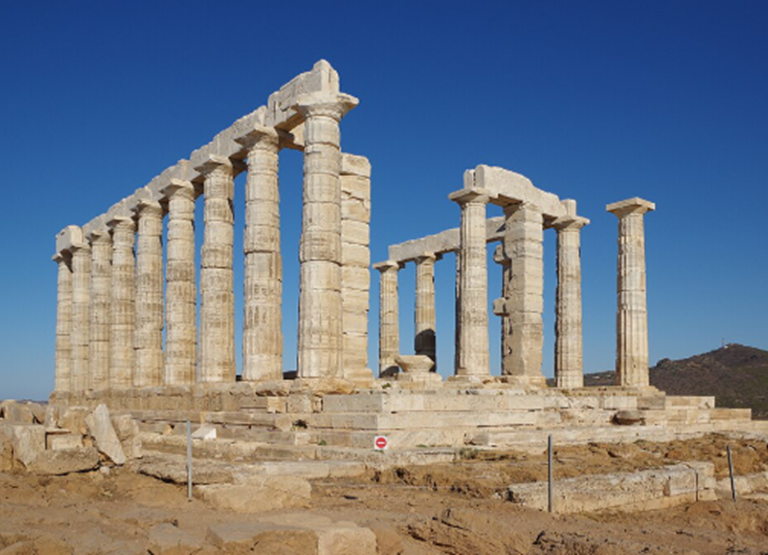
This temple was built in the 5th century BC to honor Poseidon, the Master of the Sea. It stands at the southern-most tip of Attica, about 10 miles south of the mines of the Lavrion District to the east of the Hilarion and Jean Baptiste mines.
With Fred’s presentation concluded, and after the Zoom applause died down, MSDC president Dan opened the floor for questions from the audience. They asked questions or commented on diverse aspects of Fred’s talk including, in part:
· Fred’s experience of the physical dangers in the labyrinth of the Jean Baptiste and Hilarion mines.
· How he and Vitalis harvested delicate straw-like minerals from the slag deposits of the Hilarion mine. Fred highly recommended the 1996 book authored by Piet van Kalmthout et al., titled: Laurion: The Minerals in the Ancient Slags, which may be out of print. But used copies may be available on Amazon.
· The similarity of a mineral found in Greece and in the Bisbee Queen copper mine in Arizona.
MSDC President Dan Teich again thanked Fred for his excellent presentation and the attendees applauded his very interesting presentation.
Bonus Photo (Greek Eye Candy)