
"From Stardust to Diamonds," a Quiz from the GGM Hall at the Smithsonian National Museum of Natural History
by Ken Rock, MSDC Editor
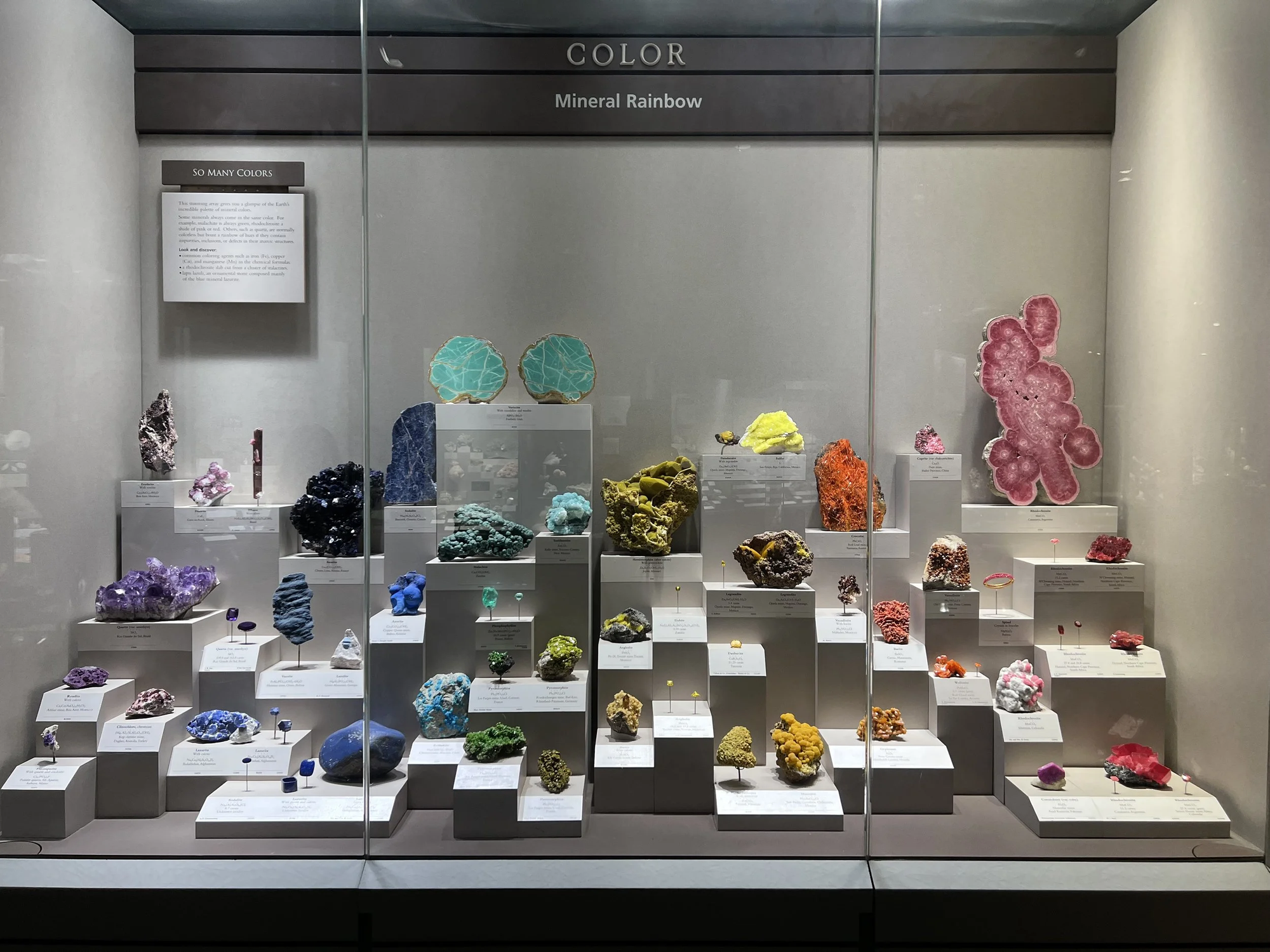
The questions in this “quiz” are from a self-guided highlights tour of the Janet Annenberg Hooker Gall of Geology, Gems, and Minerals with the title “From Stardust to Diamonds.” The tour was prepared by the Office of Education and Outreach in November 2010.
The tour was originally intended for GGM volunteers, but we thought it would be of interest to our readers and, perhaps, serve as an incentive to visit (or revisit) the GGM hall on your own – or with MSDC members who volunteer at the museum. You also can go on a virtual tour via the link HERE.
Q1: Both quartz and fluorite are clear and colorless in their pure state. What gives them color?
a) The shape of their crystals
b) Trace elements
c) Natural iridescence
A: Trace elements such as aluminum or iron give color to quartz and fluorite.
Q2: Sapphires are a variety of corundum. Can you name another precious gem that is a variety of this same mineral?
A: Rubies are also corundum. Different kinds of trace impurities cause rubies to be red and sapphires to be any other color.
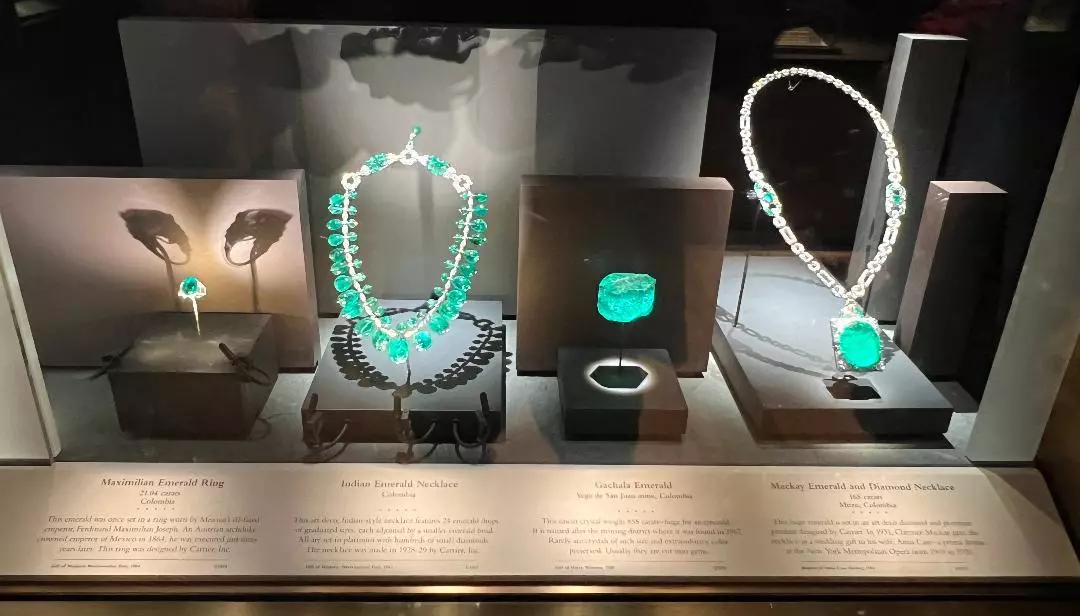
Q3: What’s the difference between a carat and a karat?
A: A carat is a unit of weight equal to 1/5 of a gram.
Q4: Where’s the best place to look for geodes (other than a rock shop)?
a) In the desert
b) In a dry riverbed
c) In a lava flow
A: In a lava flow.
Q5: Because crystal growth is sensitive to environmental conditions, scientists use them to study:
a) Volcanoes
b) Age of rocks
c) Both of the above
A: Both of the above. Crystals record temperature, pressure, and chemical changes over many thousands of years.
Q6: What allows pegmatite minerals to grow rapidly and to very large sizes?
a) Quartz
b) Uranium
c) Water
A: Water enhances the transportation of crystal-growing ingredients to crystal formations, which allows the crystals to grow fast and large.
Q7: Gold wasn’t the only important discovery made in California in 1848. What was the other one?
a) Mercury
b) Diamonds
c) Titanium
A: Mercury. It was used to separate out fine particles of gold from the rock in which it was embedded. Mercury and gold were a major impetus for the California gold rush.
Q8: How many active volcanoes are there in the world?
a) 23
b) 1,511
c) 24,232
A: 1,511. That’s according to recent Smithsonian estimates (within the range verified via a Google search on 8/27/2026), and doesn’t count active volcanoes on the ocean floor.
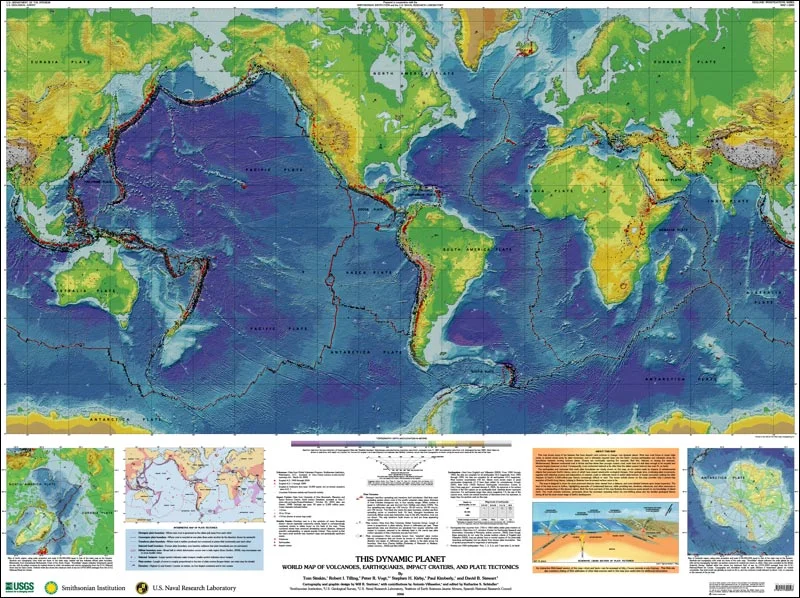
Q9: Last year, the Atlantic widened by about how much?
a) 1 meter (3.3 feet)
b) 2.54 cm (1 inch)
c) It didn’t widen
A: 2.54 cm. In another 200 million years, it may be twice as wide as it is today.
Q10: According to recent estimates, there is more water stored in rocks in the Earth’s mantle than in:
a) The Great Lakes
b) The Amazon River
c) All of the Earth’s oceans
A: All of the Earth’s oceans
Q11: Small bits of jade are often found on beaches in California. Why?
A: Jade is a product of ancient subduction of North America’s Pacific Coast: the addition of igneous and metamorphic rocks to the edge of the continent.
Q12: If the Earth is so hot, why don’t we feel the heat?
a) The Earth’s surface is insulated
b) The Sun’s incoming heat is greater
c) All of the above
A: All of the above. Like the walls of a thermos bottle, Earth’s lithosphere (the outer 100 km – or 60 miles – of the solid earth where rocks are harder and more rigid than those below) insulated the surface we walk on from the hot interior. We don’t notice the escape of Earth’s internal heat because the Sun’s incoming heat is 30 times greater.
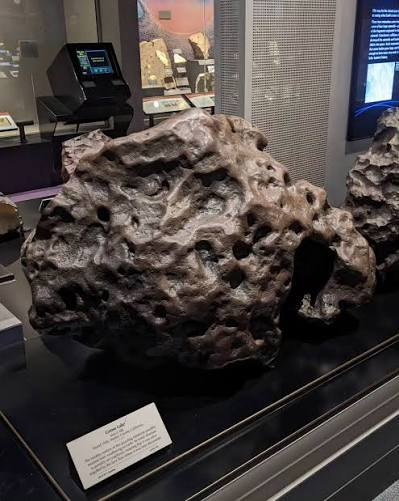
Q13: Earth’s age: 4.5 billion years. Earth’s oldest rocks: 4 billion years. What can tell us about the missing half-billion years?
a) Meteorites
b) Astronomical observations
c) Samples from deep drill cores
A: Meteorites. Most meteorites formed 4.5 billion years ago, at the same time the Solar System and our planet took shape. Scientists use meteorites to find clues about how the Earth and the other planets formed.
Q14: What’s the oldest planet in the Solar System:
a) Jupiter
b) Venus
c) They’re all the same age
A: They’re all the same age. All of the planets formed about 4.5 billion years ago.