May Program Report: The History of the Friedensville Mining District and the Birth of the U.S. Zinc Industry, by L. Michael Kaas
Synopsis by Andy Thompson, MSDC Secretary
The story of this mining site in Friedensville, PA is particularly important because it made possible the birth of the U.S. zinc industry. Prior to the 1850s, worldwide metal mining had focused on finding and processing lead. Back then, zinc was seen as a nuisance. The Friedensville mine, with its sphalerite and other mineral-rich concentrations of zinc, helped change that perspective.
Michael Kaas, a.k.a. “Miner Mike,” is a member of MSDC, a mining engineer, and retired senior executive with several U.S. government agencies and private sector companies. He began his presentation on the history of the Friedensville, PA mining district by thanking his colleagues and fellow mining historians for sharing their information, photos and explorations with him. A number of his colleagues were present for his Zoom presentation to the May MSDC meeting. He said: “We’ve all been interested in mining history… so there’s a lot of common ground here some of us have shared.”
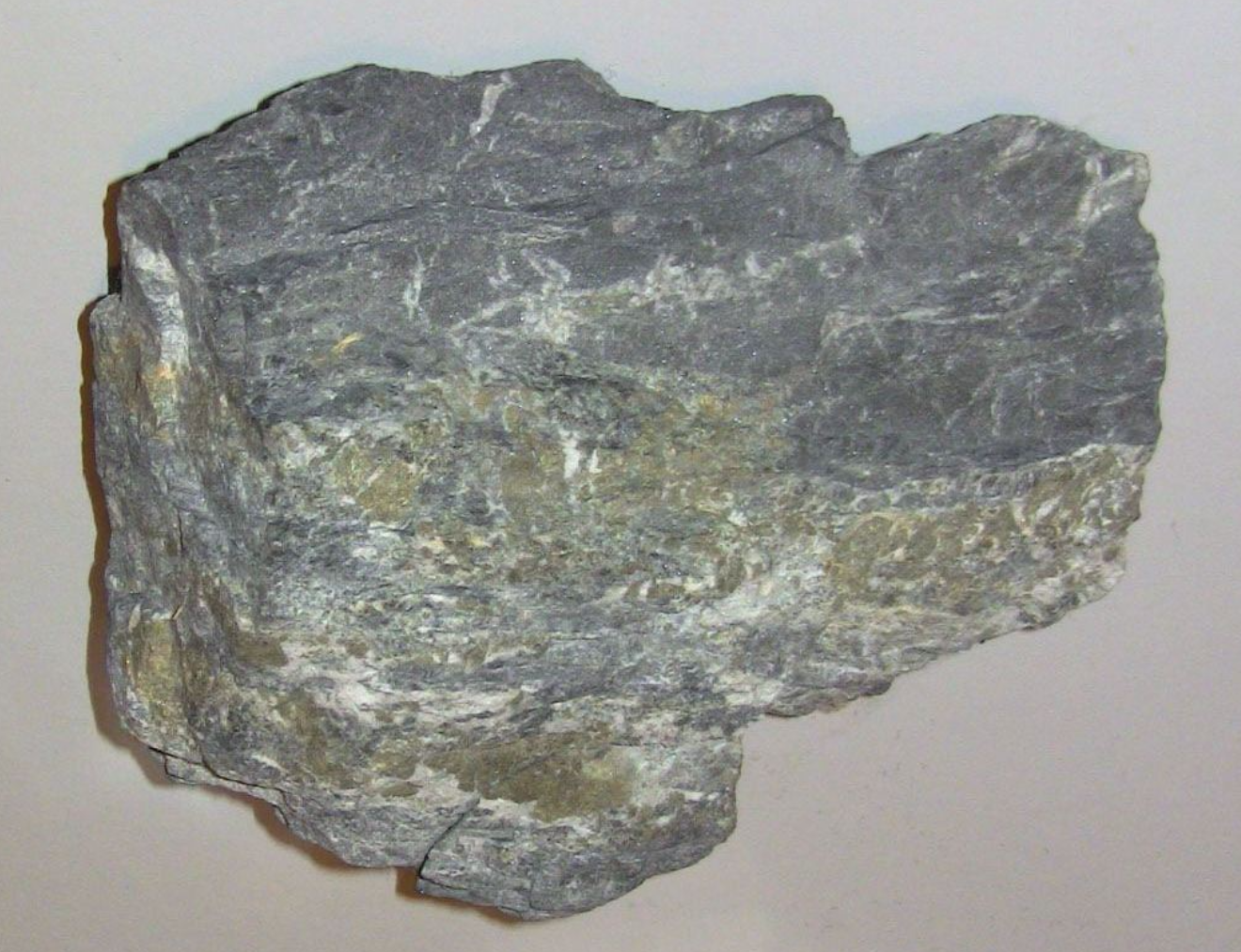
To introduce the topic, Mike noted that the zinc-rich minerals, like the one in the photo below “helped give birth to the U.S. zinc industry.”
Mike’s Personal Experience with the Friedensville Mine
Mike’s hands-on experience with the Friedensville mine began when he was an “intern” working in the mine during the summers while he was a student at Penn State University. The photos he showed pointed out the mine manager he worked with and many exterior and interior views of the mine. He noted that this Pennsylvania mine was quite different from the zinc mines in the Franklin and Sterling Hill northern NJ area because the geology is different and the PA mine had relatively few collectable mineral species in contrast to the NJ mining area which has identified hundreds of mineral species.
So, for mineral collectors, the PA mine “is not a really a good collecting place, even today, because the miners basically processed almost all the stuff they mined. I've been poking around there probably for the last 22 years or so, and I haven't really found much worth collecting.”
Over the decades he continued researching the area’s mining history, often returning there, including as recently as April 2026. That’s when he and historically-minded colleagues rescued from a mine building's loft, a previously unknown disassembled model of how the modern mine worked.
The model includes 8 frame modules, each with 16 plexiglass cross-section diagrams showing ore body geology, with sections colored to indicate zinc percentages. Miner Mike noted that the geologist who created the model spent nine months developing over 100 cross-sections, providing a detailed representation of the mine's structure and ore deposits.
Mike and the volunteer team are now putting that model back together for a museum display that will document an important part of the mine’s productivity and history.
Readers: The purpose of this Program report is to encourage you to view the video of Mike’s presentation. To learn more about the history, geology and development of the Friedensville District mining operations and Mike’s very interesting mining stories, go to the actual video of his presentation found at: The Friedensville Mining District (PA) and the Birth of the US Zinc Industry - L. Michael Kaas - YouTube. His presentation lasts about 50 minutes followed by a Q & A session for another 18 minutes.
So Where is Friedensville, PA?
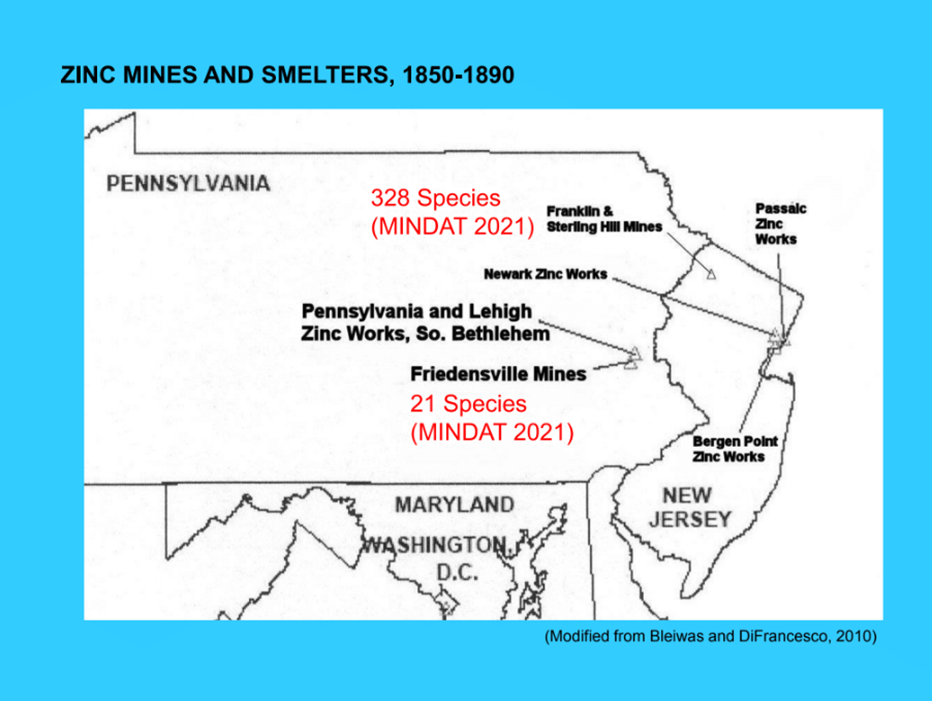
For those not familiar with Friedensville, he showed the above map of Eastern Pennsylvania and said the mining district was 4 miles south of Bethlehem, Pennsylvania, the site of Friedensville’s early smelter. He further contrasted the Friedensville District mines with the NJ Franklin and Sterling Hill zinc mines. Both sites were among the world’s greatest sources of zinc-rich sphalerite. Friedensville, however, had only 21 species of other mineral species in contrast to the NJ sites which, to date, have yielded 328 species, and counting.
The Early Development of the Friedensville Mine
Mike said that the Friedensville mining district began with the 1847 discovery of zinc by Theodore Reopper on the Ueberroth farm. The first of the eventual four major mines in the Friedensville District, the Ueberroth mine, sometimes referred to as the Friedensville mine, began production in 1853 under the direction of Samuel Wetherill who some considered a bit of a gadfly.
Soon thereafter, early in the Civil War, the mine owners managed a “hostile takeover” by bringing in the youthful Joseph Wharton to be its manager. He brought in Belgium mining expertise and expanded the mine’s productivity. Its zinc and nickel ore supported the North’s military munition needs. After three decades of entrepreneurial successes, Wharton was able to found and fund (1881) the world’s first business school at the University of Pennsylvania, the Wharton School.
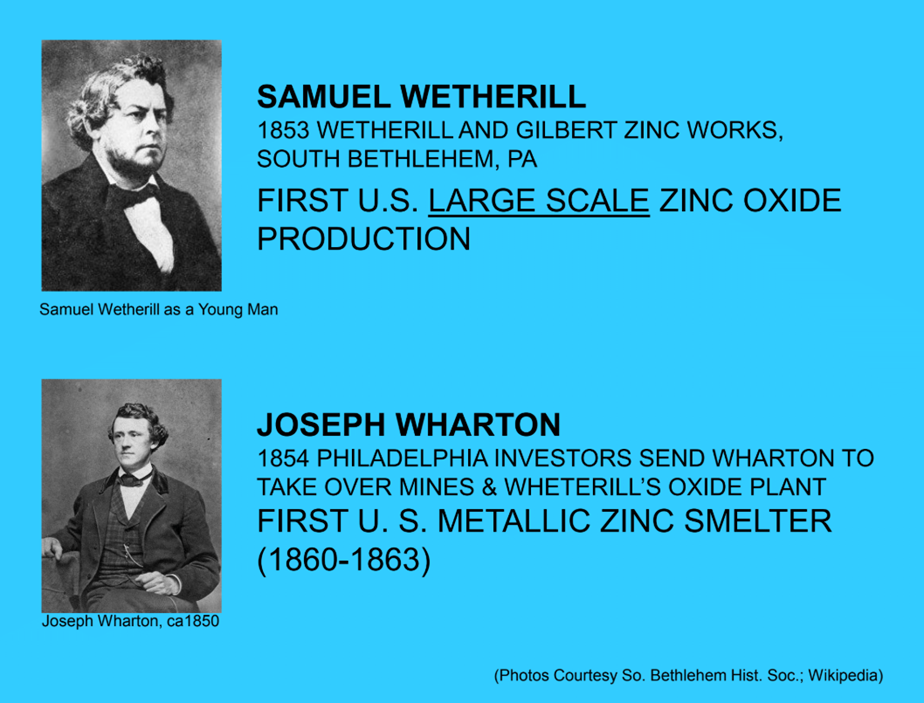
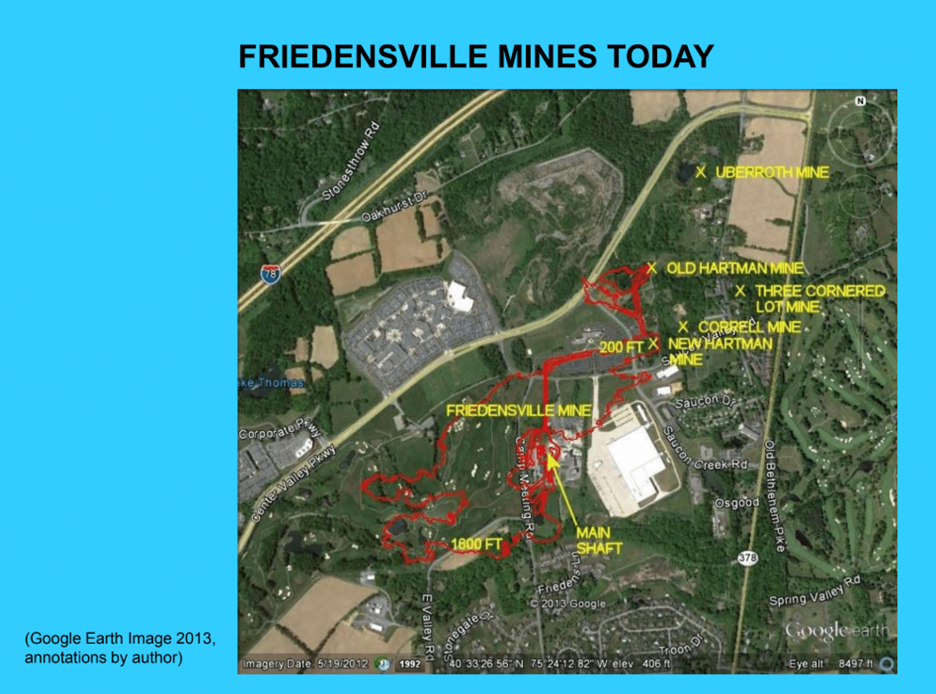
Over time, three additional neighboring mines were developed in the Friedensville District: the Old Hartman Mine, Three Cornered Lot, and the New Hartman Mine. Ownership and the names of those mines changed multiple times during the second half of the 19th century.
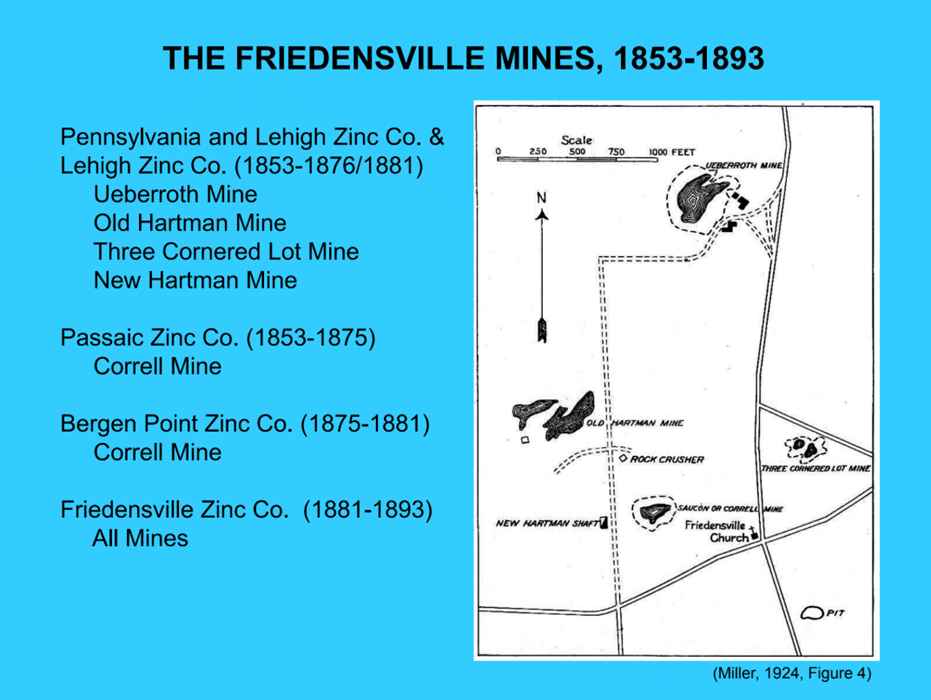
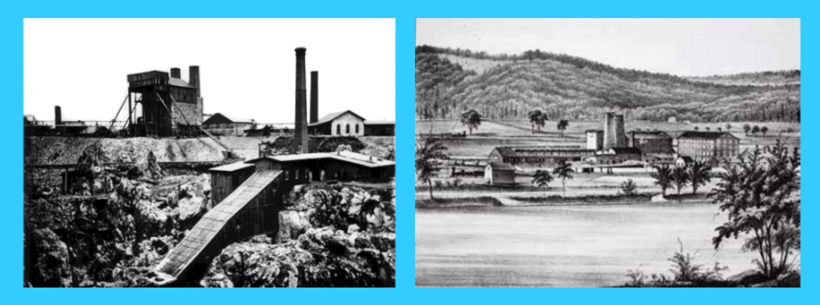
The largest and longest running mine, the Ueberroth Mine, developed along two parallel veins as shown below. Its supporting on-site buildings and equipment such as a smelter, boilers, and famous pump house are illustrated below.
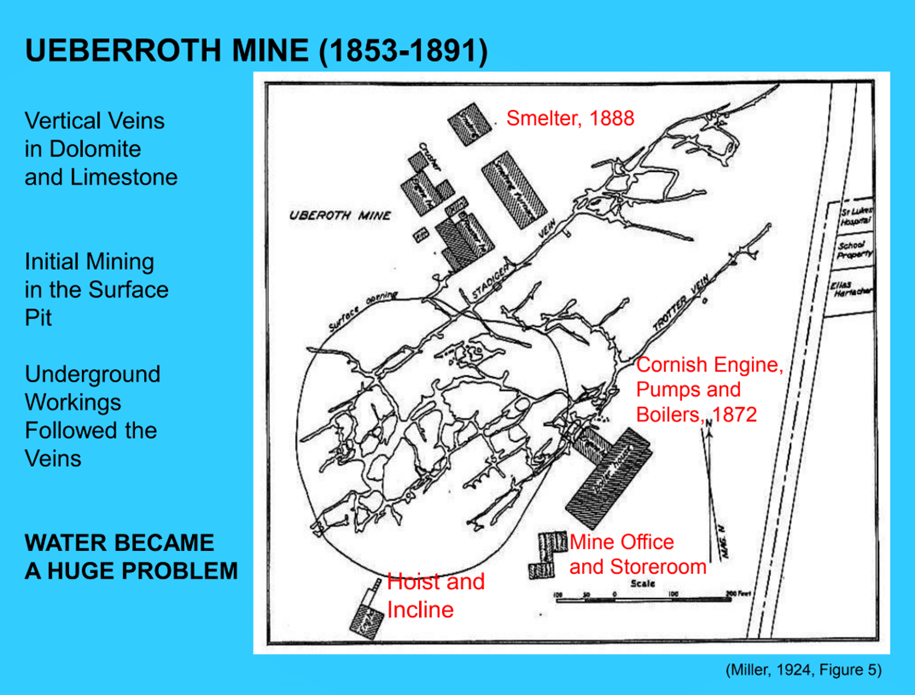
The water flooding the mine was so extensive they built the world’s largest single cylinder walking beam stationary engine ever designed and made in the United States. The pump was named “The President” in honor of President Ulysses Grant. It was recognized as an international landmark of engineering.
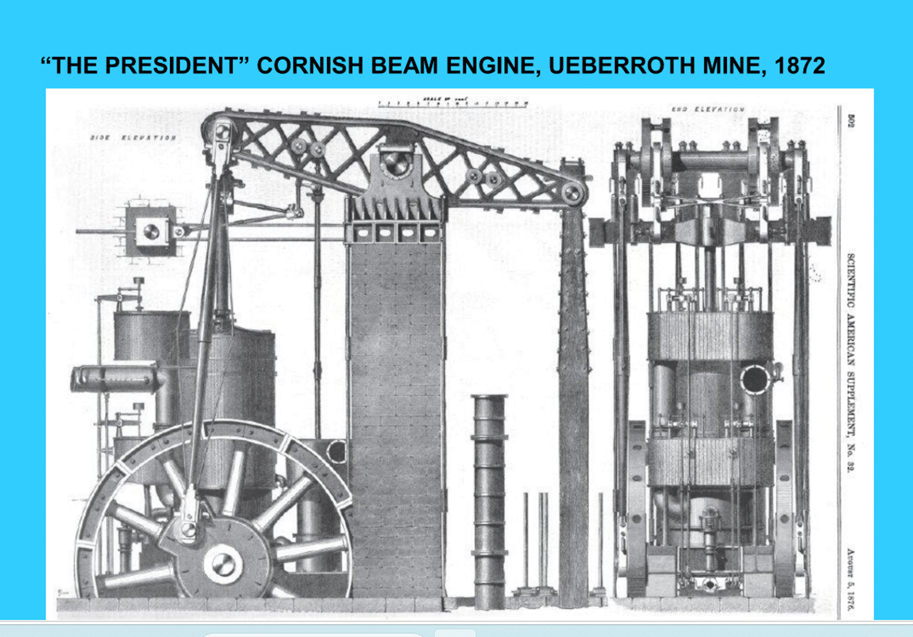
The early mine closed in 1893 when, after years of success, one expensive part of the gigantic “President” pump failed. At the time, market conditions for zinc were low and the mine’s main expense had been considerable, pumping out the water at approximately 17,000 gallons per minute.
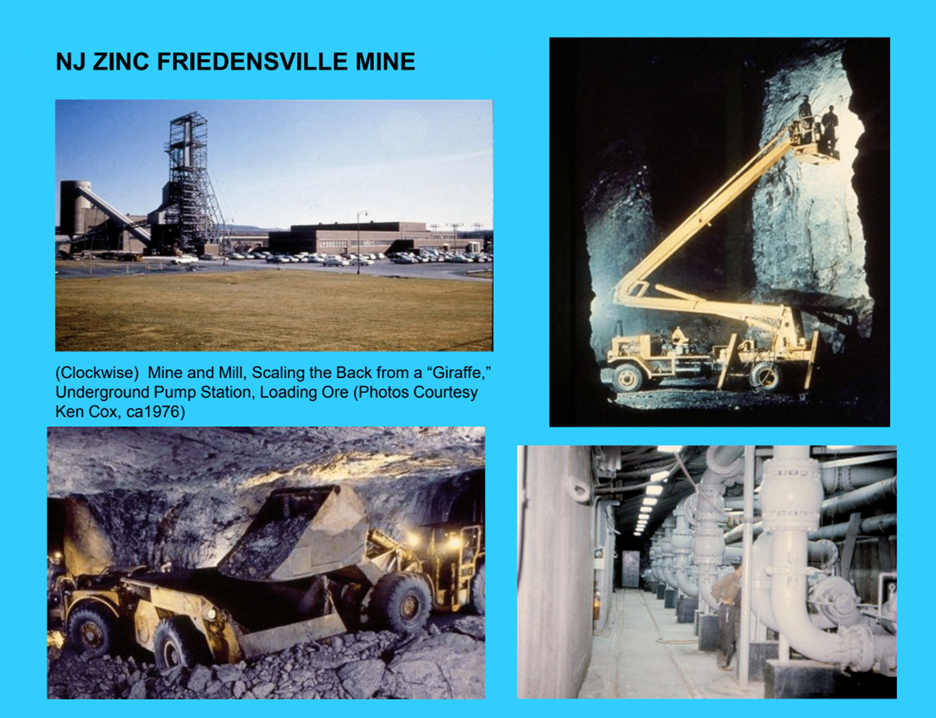
The New Jersey Zinc company subsequentially bought the site in the 1950s and zinc mining resumed in what was then called the New Hartman ore body. The new owners brought in more efficient equipment as seen in the photos below.
The first of the four photos show the mine’s main buildings as they were in 1976. Today all the frame buildings are gone. “The only thing that really remains here is the stone masonry portion of the engine house.”
Images of Zinc Bearing Friedensville Minerals
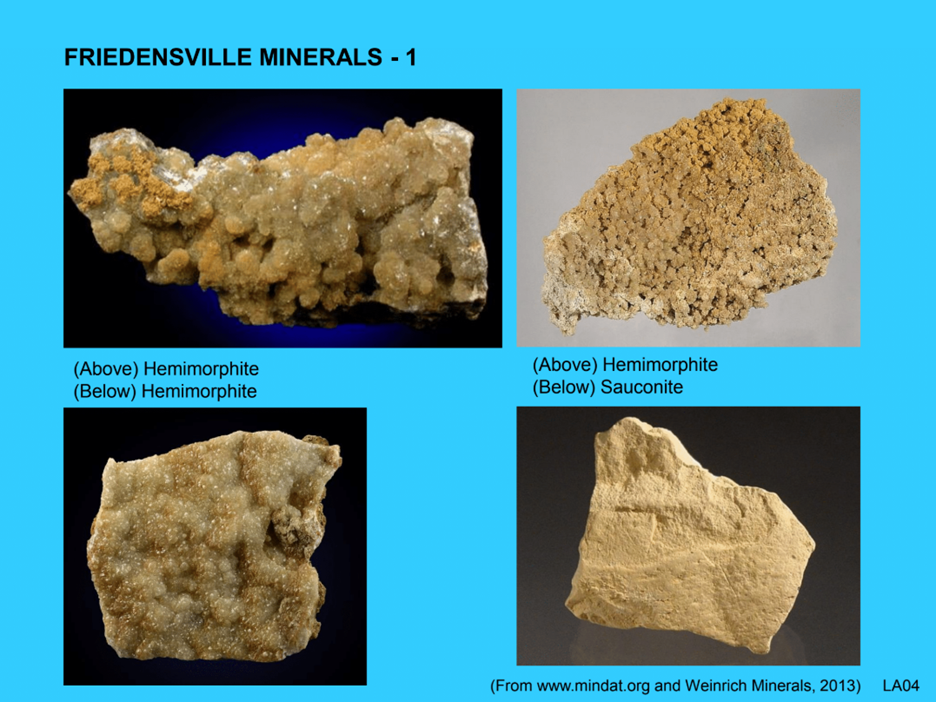
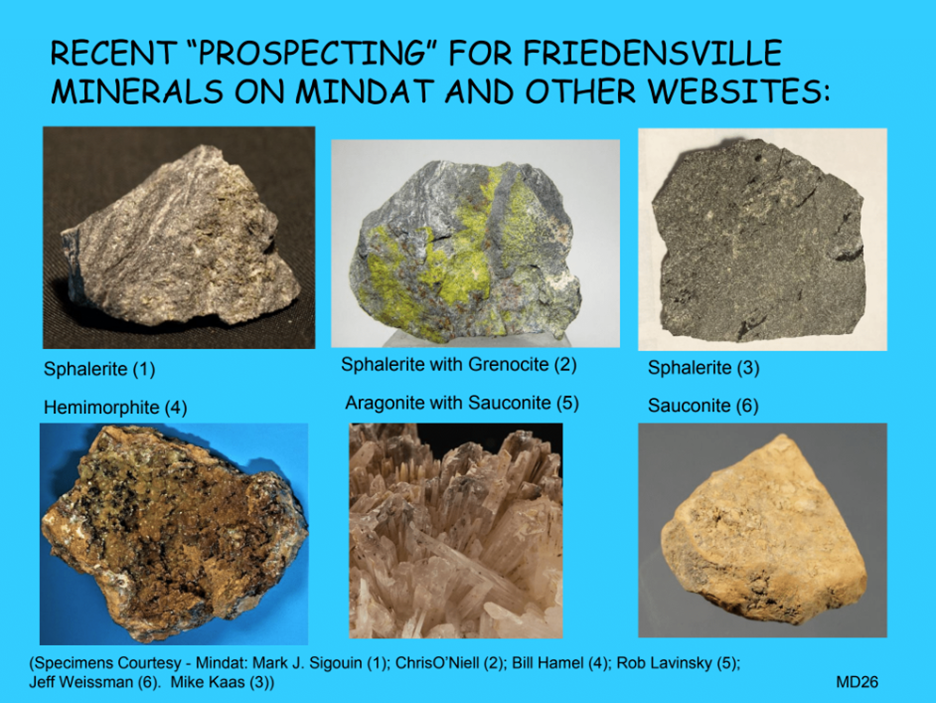
Miner Mike had to search high and low to find the images of zinc bearing minerals shown below. Some of his sources included museums, mineral dealers, private collectors, and mindat.org. The scarcity Mike said, was because the early and later miners processed all the available ore to extract the zinc, leaving little for future generations of collectors. The dull brown sauconite below, for example, is clay, and easily overlooked by collectors. But the early miners knew it was rich in zinc and definitely worth processing, so they left little behind.
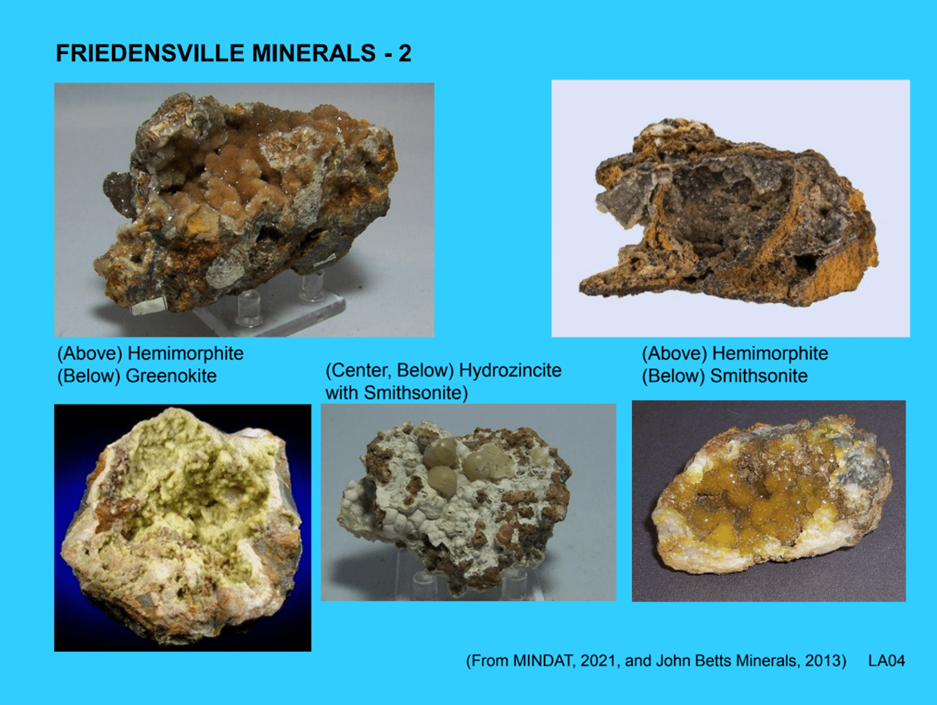
The greenokite (CdS) specimen (above left) is an interesting rare cadmium-bearing metal sulfide found in the area and contains no zinc. Another greenokite specimen with sphalerite is shown in the images below.
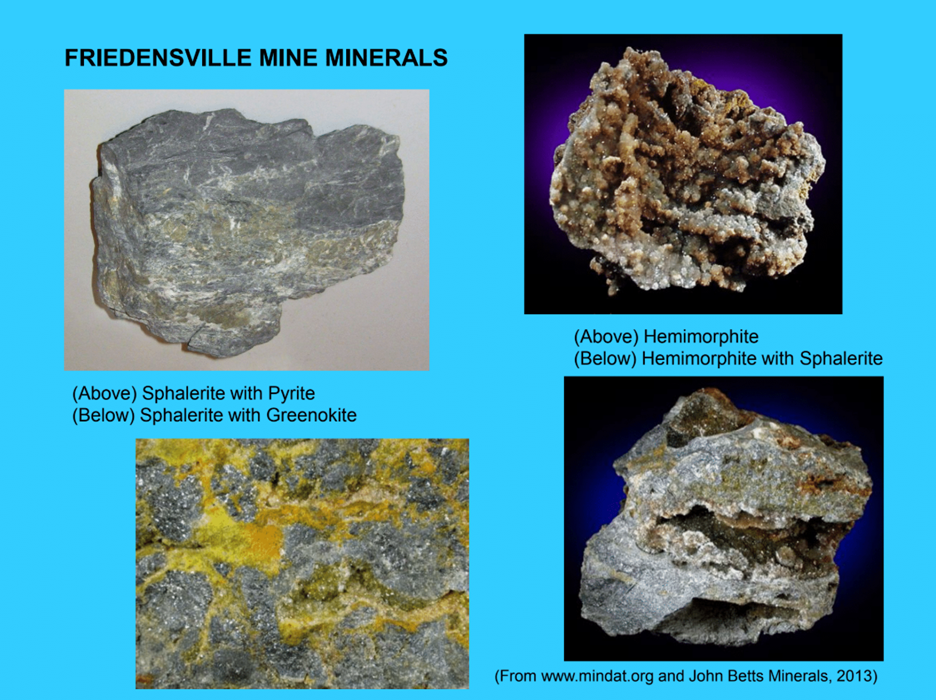
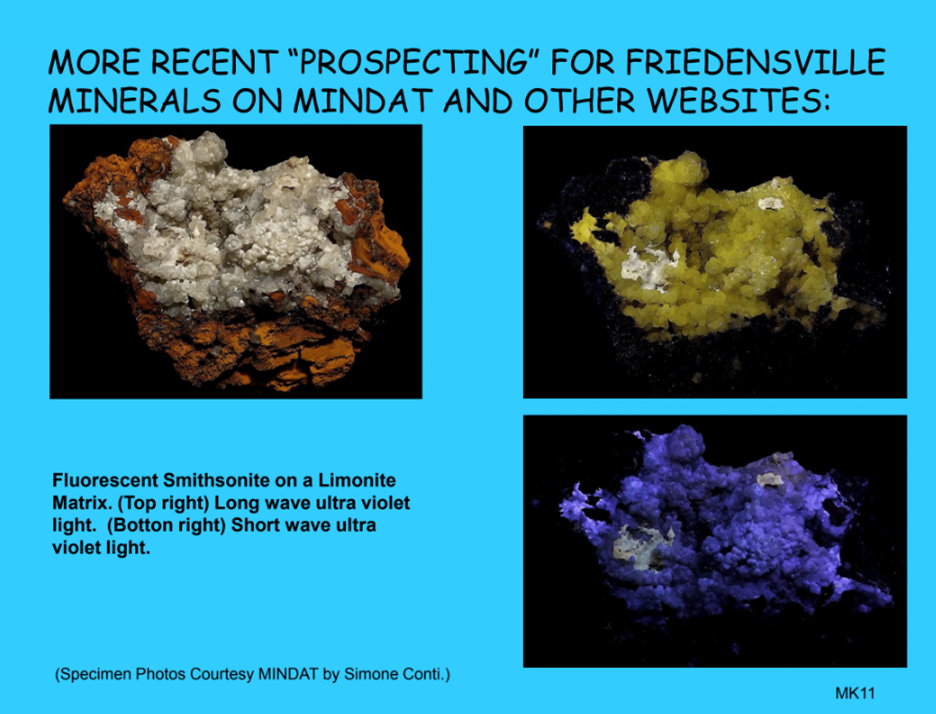
Though Friedensville mineral specimens are few in number, all are interesting as shown below.
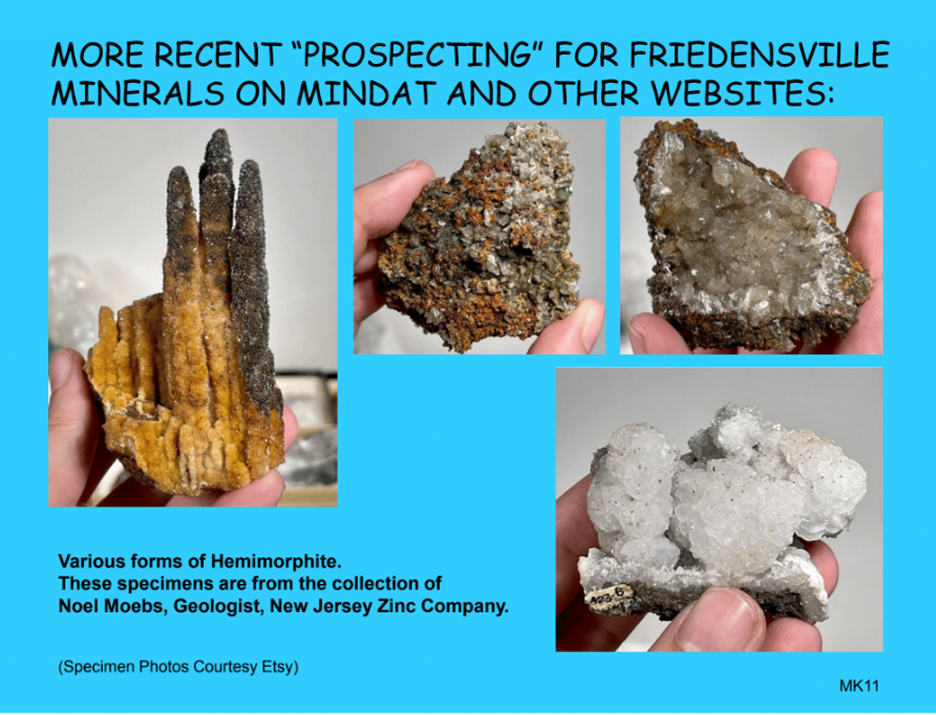
Concluding Portraits
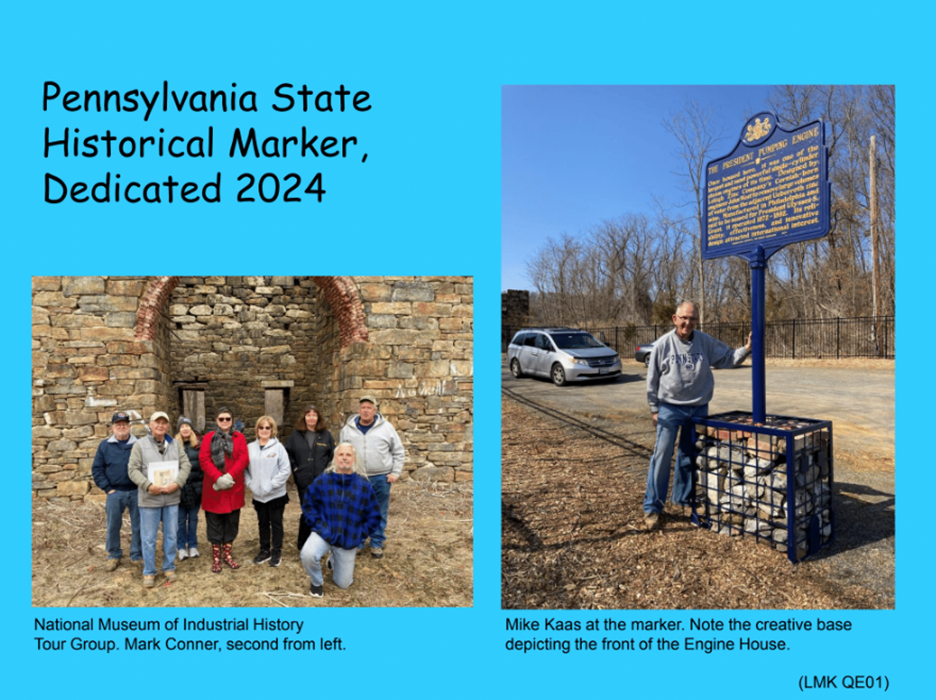
Mike began his presentation thanking his historically minded colleagues for their support. The photos below show their 2024 visit to the site and Mike standing next to the State’s historical marker.
For more information, be sure to view MSDC's YouTube channel for a video of Mike’s presentation in May of 2026.
Readers: Along with the video of his presentation, Mike wants you to have access to all the slides he used to illustrate his talk. His entire slide deck can be accessed by clicking in the box below.
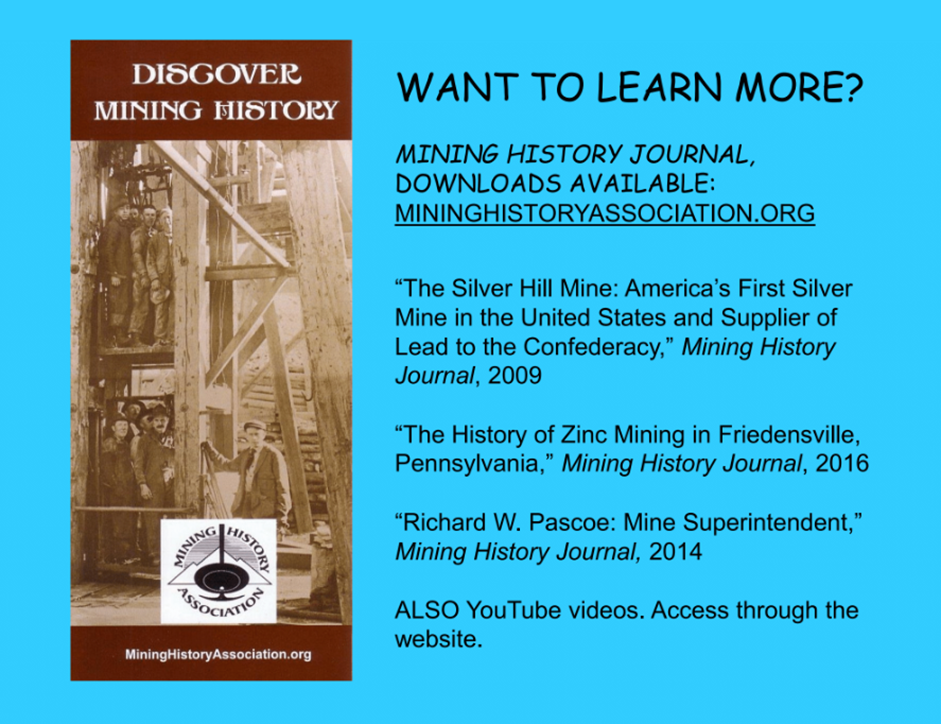
Mike also provided additional sites below where you can read his historical reports on the Friedensville Mining District. The Mining History Journal article of 2016 elaborates (26 pp) this interesting story. He also provided his personal contact information.