My New Favorite Mineral
By John Weidner, MSDC Treasurer

Moolooite! How can you not love a mineral named moolooite! Moolooite is a biomineral, meaning its formation is linked to biological activity. It typically forms when oxalic acid produced by organisms like lichens or found in bird guano reacts with weathering copper sulfides or metallic copper. Its color is typically turquoise-green, but can range from blue to green. According to Wikipedia:
Moolooite is a rare blue-green mineral with the formula Cu++(C2O4)·n(H2O) (n<1), making it a hydrated copper oxalate. It was discovered in 1986 by Richard M. Clarke and Ian R. Williams in Bunbury Well, Mooloo Downs Station, Murchison, Western Australia. It has an orthorhombic crystalline structure, and is formed by the interaction of bird guano with weathering copper sulfides.
A second occurrence is reported from the Sainte-Marie-aux-Mines silver mining district of Vosges Mountains, France.
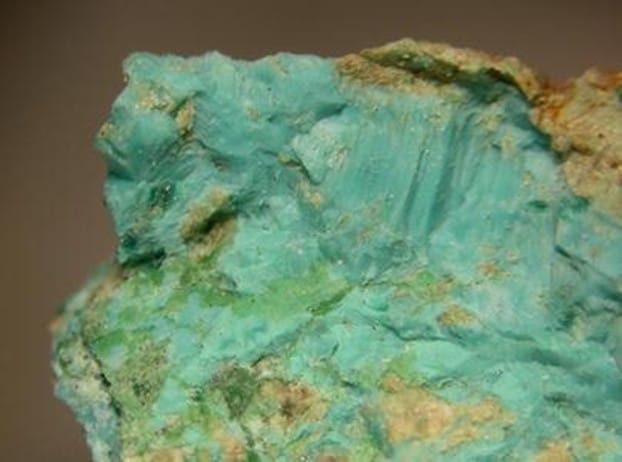
“Formed by the interaction of bird guano with weathering copper sulfides.” You gotta be kidding!
Mindat lists the properties of moolooite, of course, but mentions that the reported density was calculated theoretically from its chemical formula, because it “could not be measured due to scarcity of pure material.” How about this! If you’ve got some weathering copper sulfides, I’ll get some birds, and we can contribute to geological research.
Moolooite is a biomineral, meaning its formation is linked to biological activity. It typically forms when oxalic acid produced by organisms like lichens or found in bird guano reacts with weathering copper sulfides or metallic copper.
Mindat also reports that there are now 15 locations at which moolooite has been found, including one in Michigan and another in Utah. It appears as powdery coatings in cracks or cavities, often resulting from the interaction between organic acids and weathering copper sulfide deposits.
But wait a minute: According to Dana classification, moolooite is an organic mineral. This makes me wonder exactly what is going on, not just with moolooite, but also with this whole Dana category.
Another definition of mineral is “Any substance produced by geological processes.” Now I never considered birds pooping to be a geological process, but maybe that’s just me.
And finally, I realize the mineral is named for the location where it was first found, but I gotta ask: If a mineral is found that is formed from the interaction of cow pies and copper sulfides, will they name it Moomooite?