
Objective Diamond Clarity Grading: We Think We’re Being Subjective, but Our Brain is Doing the Math
By Gary Roskin, GG, FGA, Roskin Gem News Report
Diamond clarity grading has always been considered subjective. An experienced grader looks at a diamond and says, “That looks like a solid SI₁ to me.” But why? What is our brain seeing that tells us SI₁ is more appropriate than VS₂ or SI₂?
Years ago, after hearing a presentation about Fibonacci, the Golden Ratio, and how our brains recognize aesthetically pleasing proportions mathematically, I posed a question to my friend, Michael Cowing. Perhaps something similar was happening with diamond grading.
“Is our brain doing the math?”
Cowing took that question and did what Cowing does. He did the math.
Using objective metrics for inclusion size, contrast, number, and position, Cowing developed a system that closely correlates with the familiar GIA clarity grades. And remarkably, he found an approximate fourfold increase in inclusion area from one clarity grade to the next.
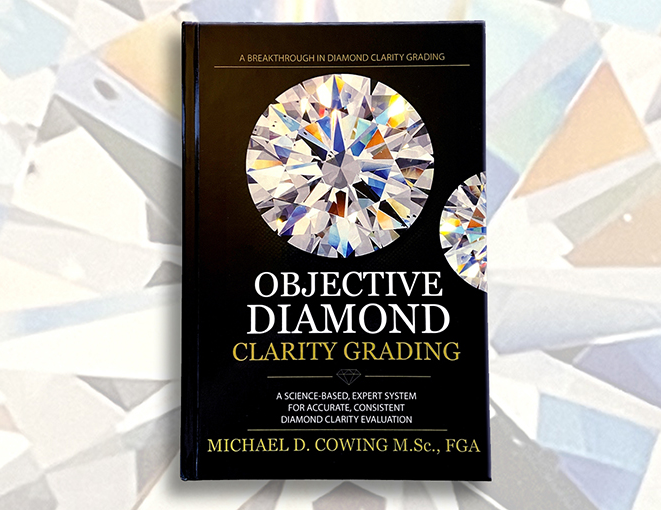
The work itself isn’t new. Cowing published Objective Diamond Clarity Grading in The Journal of Gemmology in 2014, and it has long been available through his website here. Michael’s work has also made its way into the classroom. Geoffrey Dominy of the World Gem Foundation uses it in teaching diamond grading.
What’s new?
It’s finally a hardback book!
Michael asked me to write the foreword way back when, and in it I tell a little more of the story behind his decades-long pursuit of putting mathematics to what we gemologists have traditionally called subjective clarity grading.
Here is a link in my newsletter that includes that Foreword – Objective Diamond Clarity Grading.