
October Program Report: Siderite, Barite, and Millerite from the Mount Savage Clay, Frostburg, MD presented by Dr. Jacob Margolis
Synopsis by Andy Thompson, MSDC Secretary
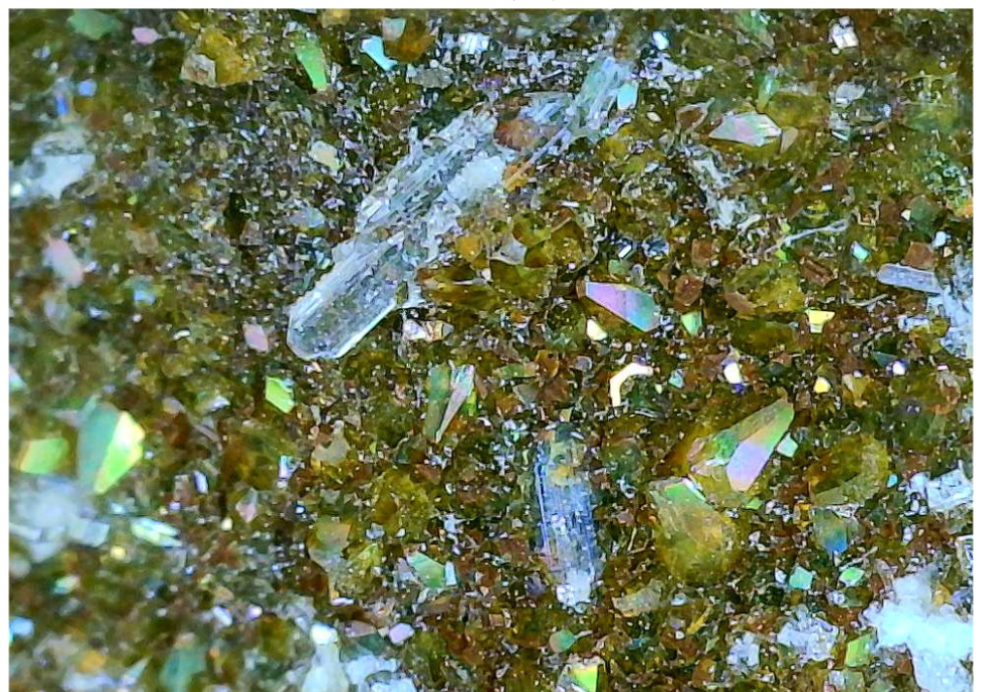
Quick Overview
Dr. Jake Margolis, economic geologist and MSDC member, focused his presentation on his findings from field trips and research on siderite and other minerals within the Mount Savage clay mining region near Frostburg, Maryland. He explained the mining history of this unique fire-resistant clay which was highly valued because it was needed to make heat-resistant bricks and essential for use in iron forges especially in Pittsburgh’s late 19th and mid-20th century steel blast furnaces. Jake explained the geology of the mining area and focused on the minerals of clay layers found just beneath the region’s coal seams known as “underclay,” which represent soils below the swamps that would later become coal.
He showed the vertical stratigraphic column below to illustrate that the position of the Mount Savage coal and clay, the focus of his field exploration, which dates back about 310 million years, to the lower Pennsylvanian subperiod. The underclay layer is about 8 to 14 feet thick. Coal is shown by the black layers, and the underclays are in red.
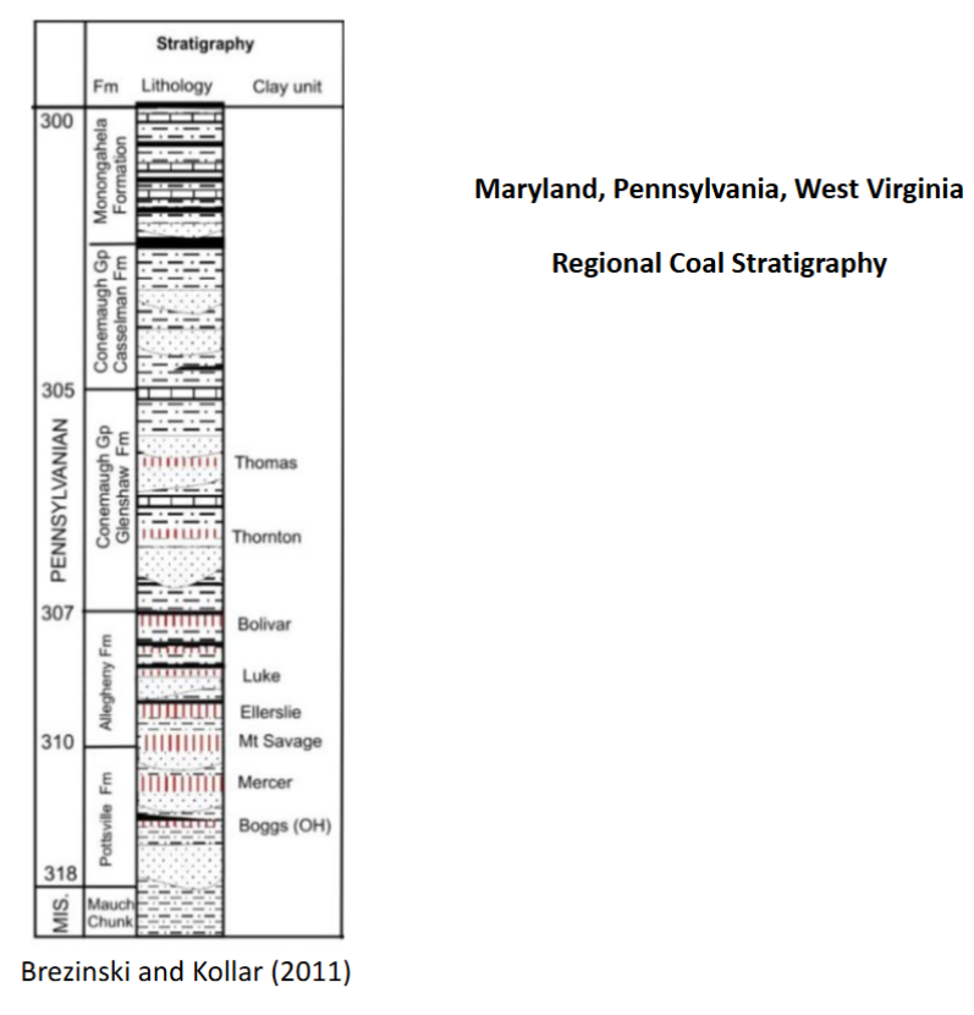
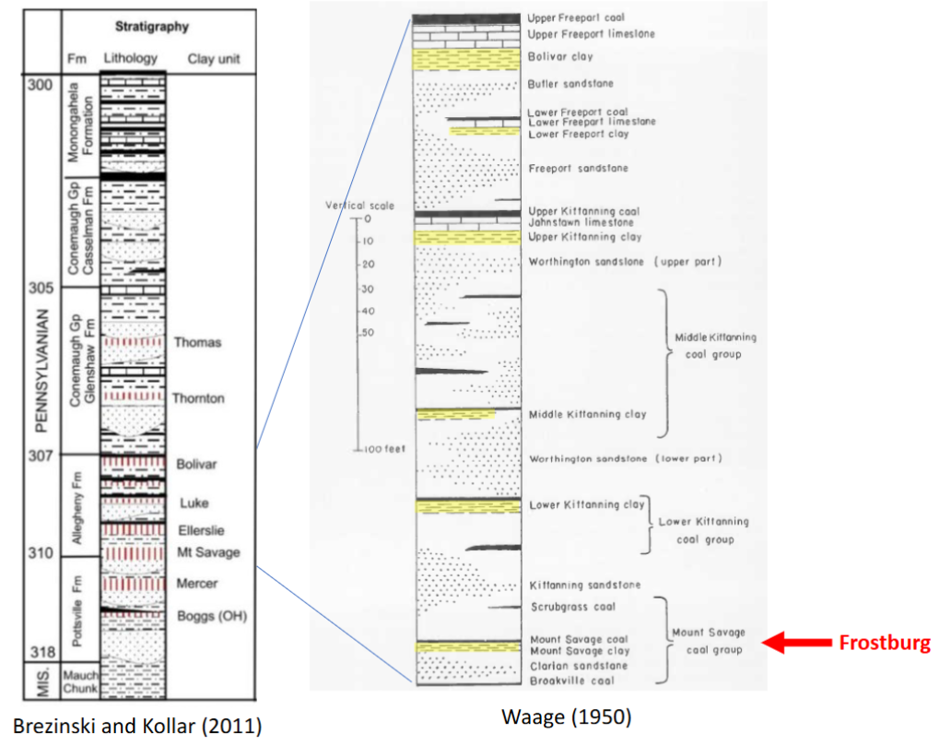
The above column at the bottom right, highlights the Frostburg geologic layer which illustrates the time frame for the formation of the area Jake explored.
Formation of the Mount Savage Clay
Jake also mentioned an interesting connection between this coal strata which is found today on both sides of the Atlantic Ocean. About 200 million years ago, before Pangea split apart, the area we now know as the Allegheny Mountains of western Maryland (including the Frostburg area) was continuous with the land mass of what is now Wales, on the westernmost side of the United Kingdom.
Thus, the coal mines in Eastern U.S. and in the Western United Kingdom were once united before tectonic forces pushed the continents apart and the Atlantic Ocean began to fill in the empty space between the diverging continents. The shared ancestry of the coal deposits on both sides of the Atlantic Ocean is why Jake and other geologists sometimes compare the mineralogy of these two world-famous coal regions.
He then began showing his beautiful photos of the relevant minerals, most of which he took himself. He focused on the three minerals he found particularly interesting.
Readers: we provide this Program Report overview to encourage you to watch the YouTube video of Jake’s excellent talk. Because he spoke about micromineral crystals, it is particularly import to watch his cursor’s movement as he explains what he sees in the photos of the crystals and the geologic stories they tell.
The video also contains helpful illustrations of the many faces of the three minerals’ crystal structures. Jake’s richly illustrated talk and a brief Q&A lasts about 54 minutes. You can enjoy it by clicking on the link HERE.
Intro to the Three Minerals Jake Discussed
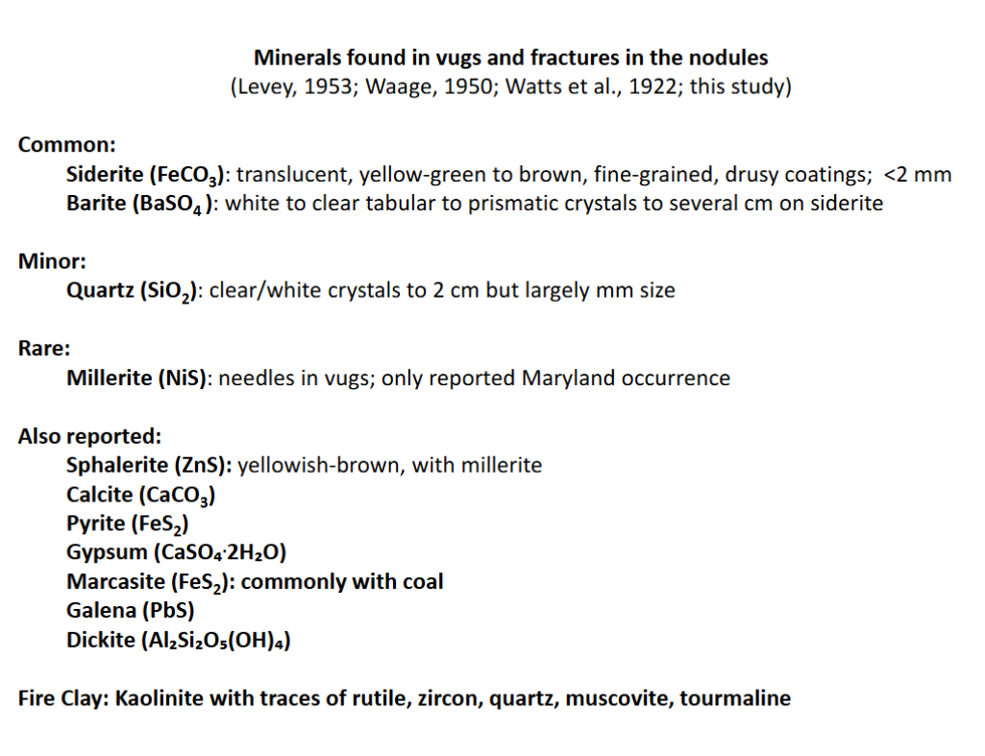
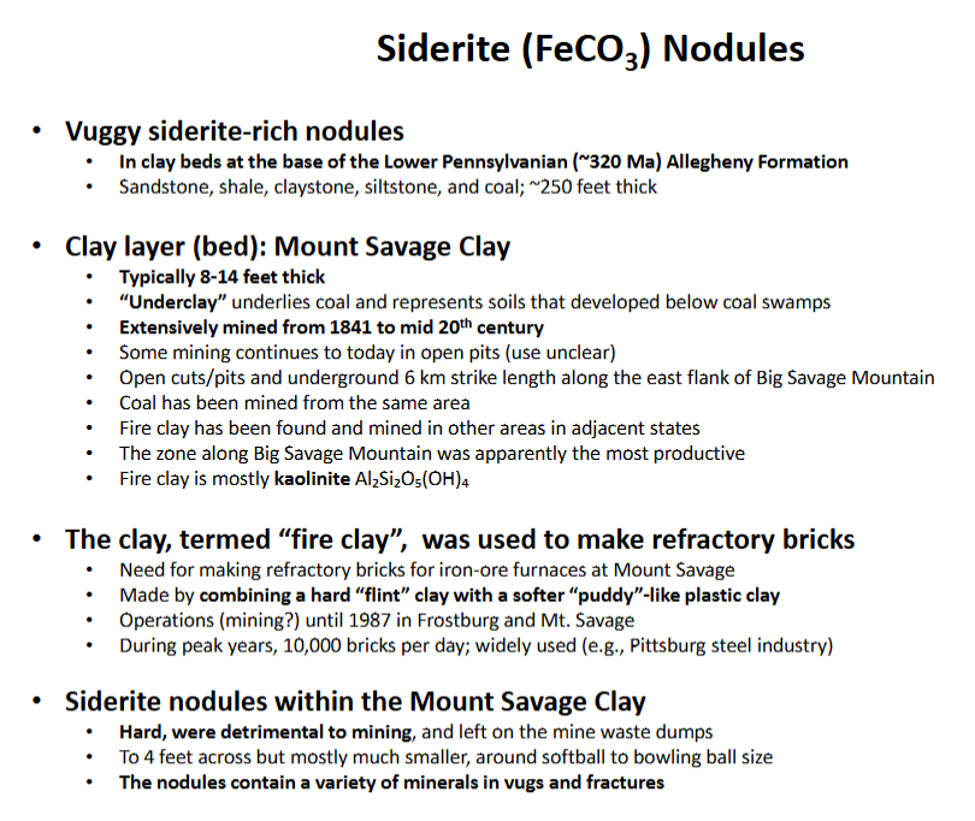
The Mount Savage clay, as noted further below, contains nodules of massive fine-grained siderite. Vugs (open spaces) and fractures within the nodules contain coarser crystals of siderite, barite, and rare millerite. These are the three minerals Jake focused on:
· Siderite, FeCO3 found in hard, lumpy nodules and in multiple crystal habits;
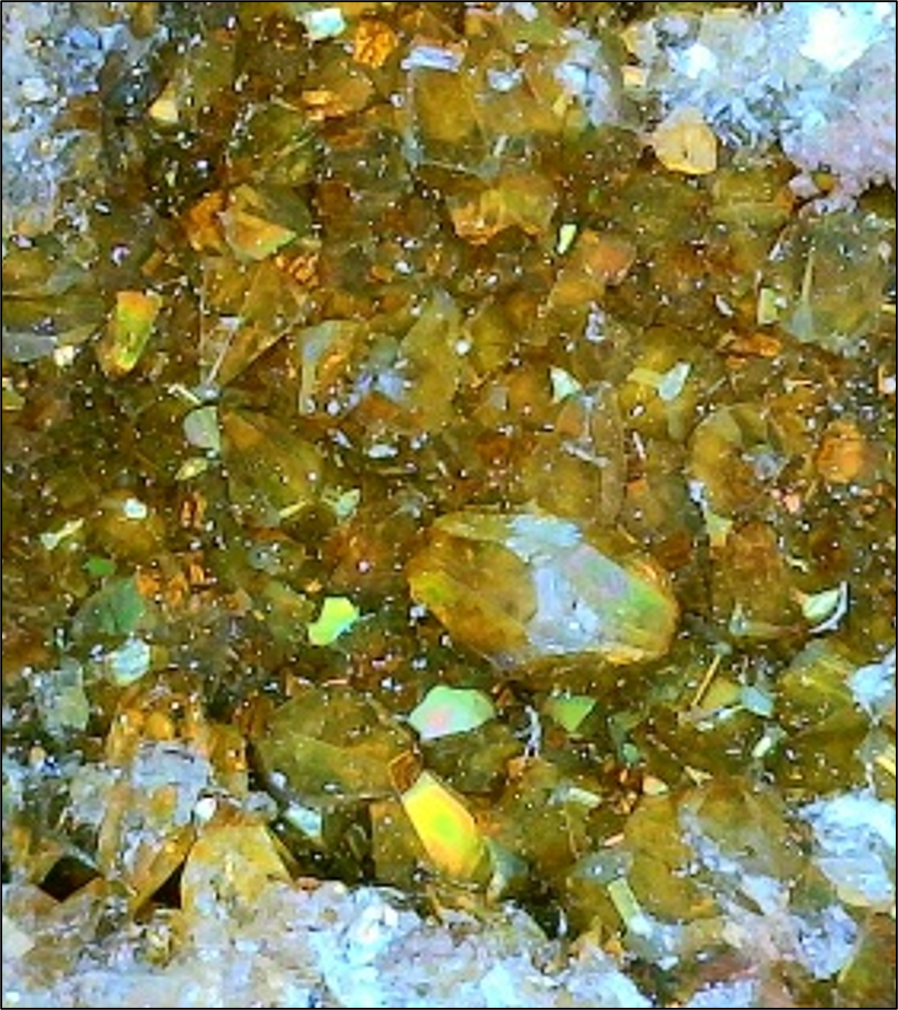
· Barite, BaSO4, also has multiple crystals shapes that are bladed, columnar, or prismatic, and also some that are feathery or with radiating clusters; and
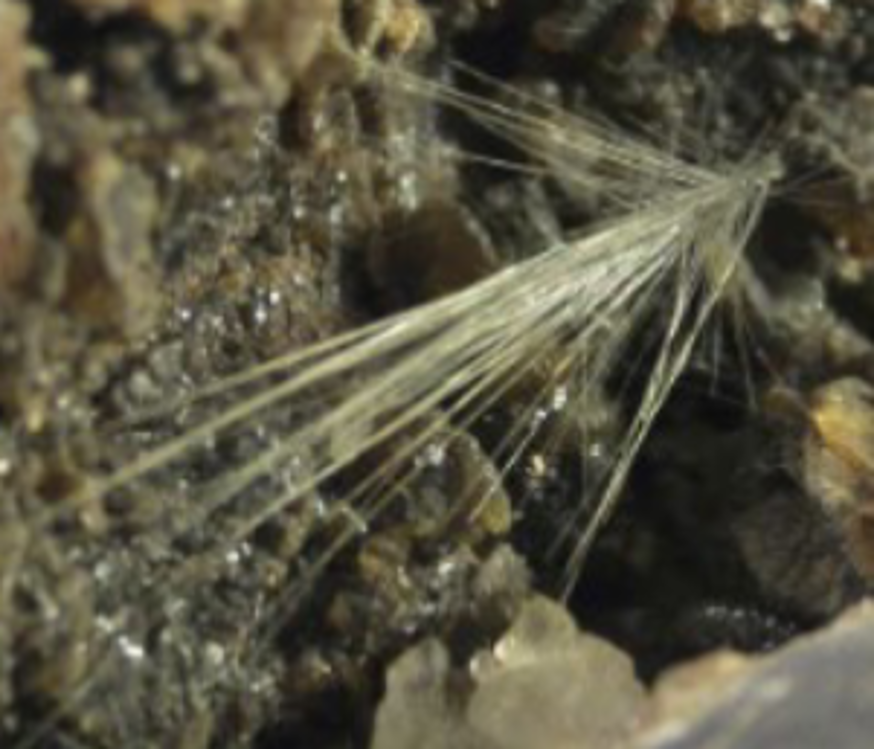
· Millerite, NiS, a nickel sulfide, is rare and its habit is delicate needle-like sprays shown below.
What Sparked Jake’s Interest in these Microminerals?
Jake started his presentation by sharing that during his career he had always preferred to work with large mineral specimens “that I could see from across the room,” rather than microminerals. So, he explained how he recently took an interest in researching Maryland’s siderite, barite, and millerite microminerals.
Five years ago, Jake retired from his three decades of doing fieldwork for mining companies exploring for gold in Western U.S. and Canada and returned to the DC area. He wanted to get back into the field and to work with some of the local metallic mineral occurrences. Online, he saw an ad that caught his attention, someone selling a Maryland siderite specimen, an iron carbonate mineral found near Frostburg in western Maryland.
Jake did some research to figure out exactly where the siderite came from, and with local colleagues Fred Paraskevoudakis and Marco Molinaro, made a few trips to collect specimens of the siderite nodules. His presentation to the MSDC mineral club shared some of his findings.
The Layers and Minerals of Mount Savage Clay
The fire clay, with its hard siderite nodules, harbored the two additional minerals, barite and millerite, which Jake also found interesting. They reportedly were found in the bed of clay about 12 feet thick within the Lower Pennsylvanian Allegheny Formation, illustrated in the stratigraphic columns shown above. Jake and his colleagues found no millerite.
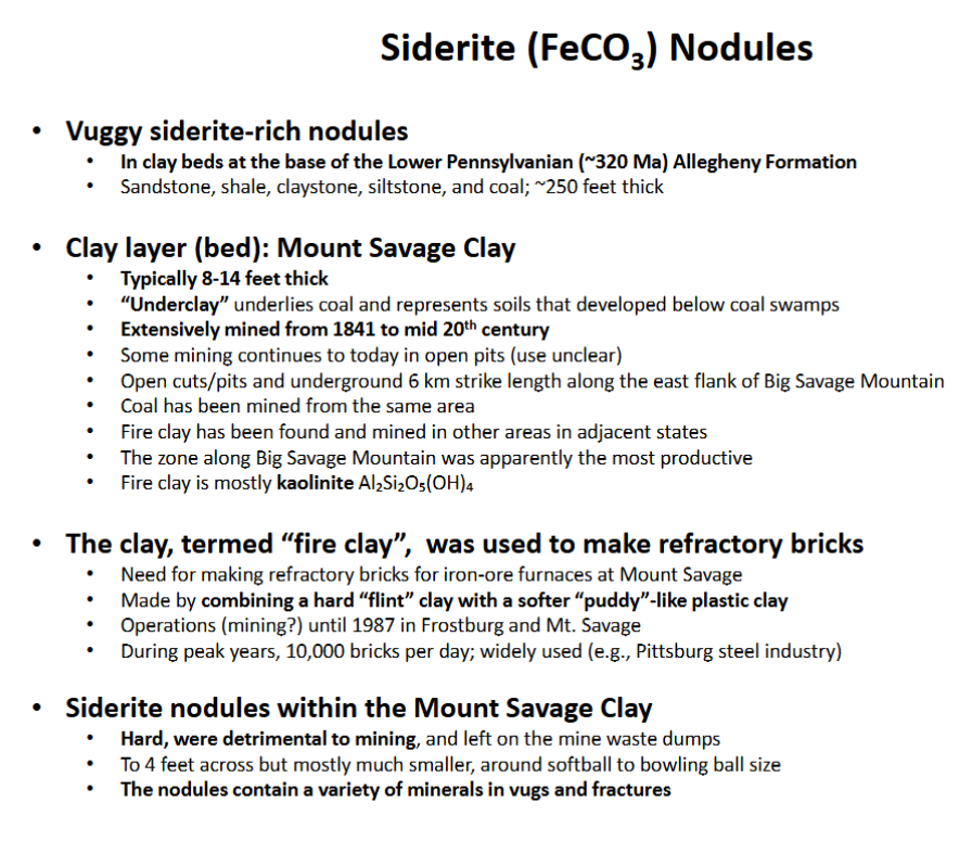
The fire clay is part of a 250-foot thick sequence of sandstone, shale, claystone, and coal. The old Frostburg Mine #6, an open pit a couple hundred yards north of Route 40 on the east flank of Big Savage Mountain, is the main collecting site. The clay which was once beneath the coal probably began as the soil under the original coal swamps. It is now mostly kaolinite along with the refractory minerals left behind, such as quartz, zircon, rutile, and tourmaline. That combination, Jake believes, points to the probable presence of acidic waters that leached down through the soil.
The History of the Fire Clay Use in the U.S.
This “fire clay” was mined from about 1841 to at least the mid-20th century. But before its utility was discovered, the iron furnaces operating near Mount Savage required importing refractory bricks from England at great expense. Brickmaking began in the village of Mount Savage, combining a harder clay with a softer, putty-like clay.
At its peak around 1900, production reached as many as 10,000 bricks a day. Mount Savage Specialty Refractories in Pittsburg still makes such bricks today, and one small pit near Frostburg is still an active source of the clay. Over a century ago when mining was active, the hard siderite nodules hindered mining operations and were left on the dumps. Their other interesting minerals were noticed as early as the 1920s. Most of the nodules are softball to bowling ball in size.
Summary Info about the Siderite Nodules
Beyond the siderite itself, Jake found other minerals in the nodules.
Siderite Comes in a Varieties of Habits
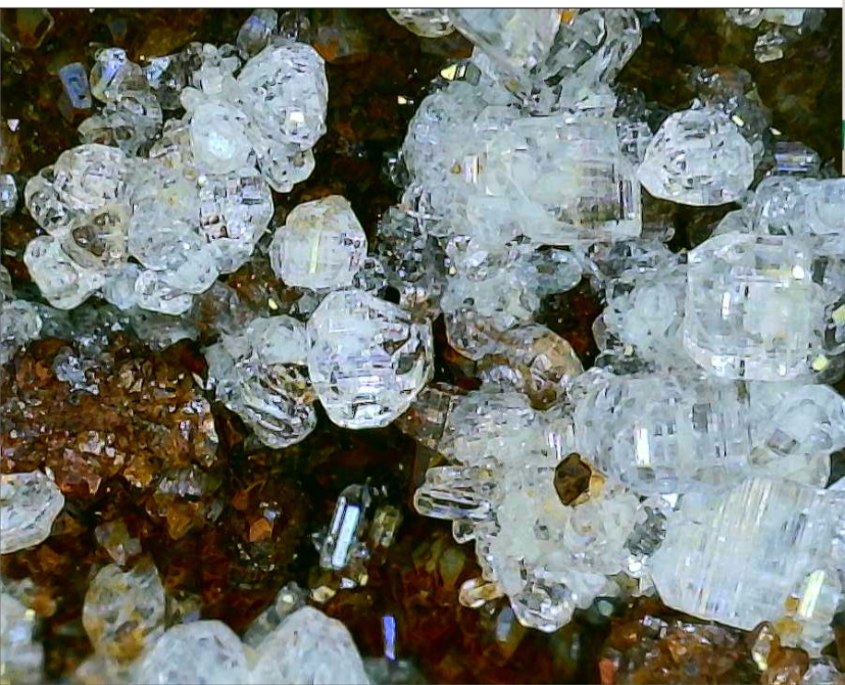
The images below shows one of the many habits of siderite crystals.
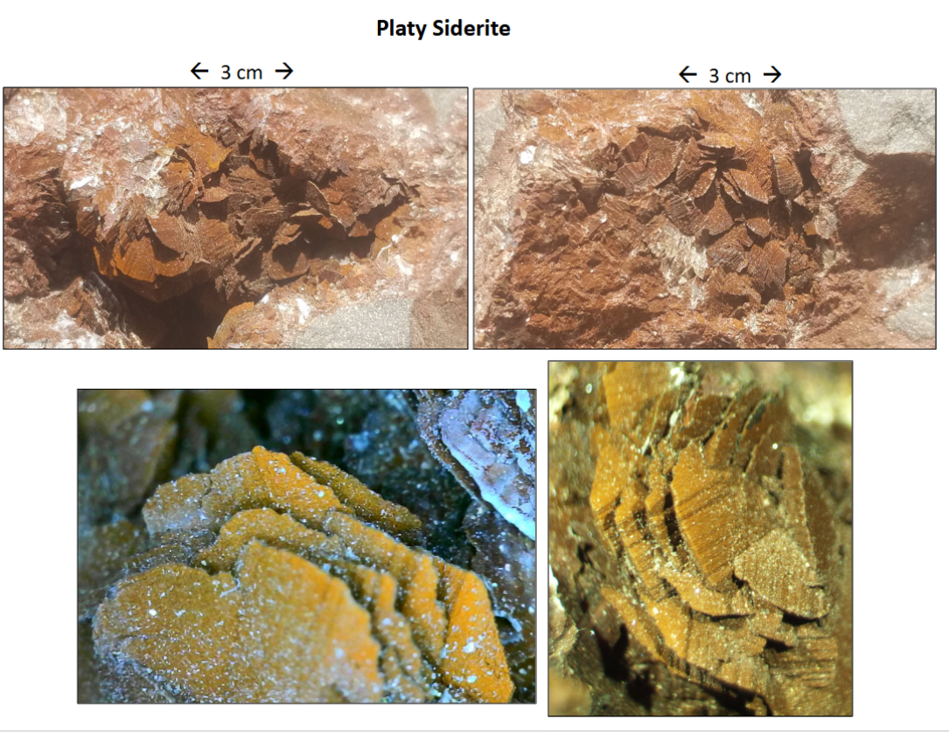
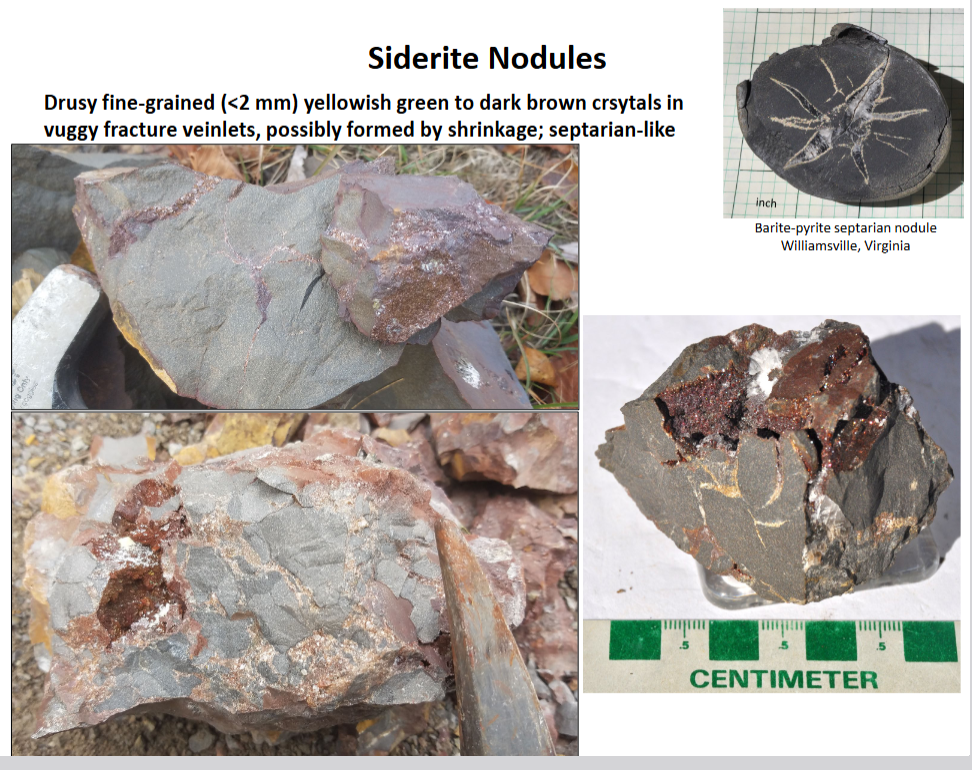
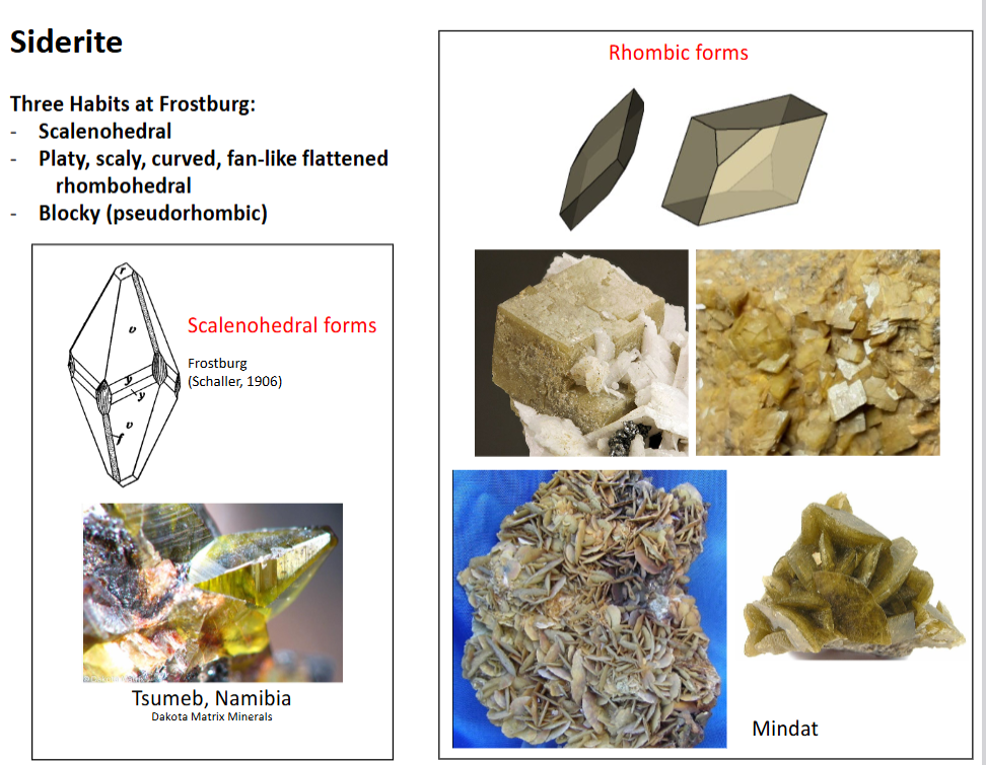
Most nodules are massive siderite, but many contain fractures and vugs lined with drusy, often iridescent siderite, much like septarian nodules. The vugs hold crystals with three main habits: sharp scalenohedral (dogtooth) crystals, flattened scaly or platy rhombs and tiny blocky, pseudorhombic grains.
Frostburg siderite became known in 1906 when Schaller drew a scalenohedral crystal in the American Journal of Science. The form is uncommon worldwide. The Frostburg crystals are small, pointed or truncated, and more translucent than the rhombic ones.
Jake said he was particularly interested in seeing that some scalenohedral crystals show linear ridges with a cloudy white line along the center of the crystal formation. Jake showed an example in the slide below:
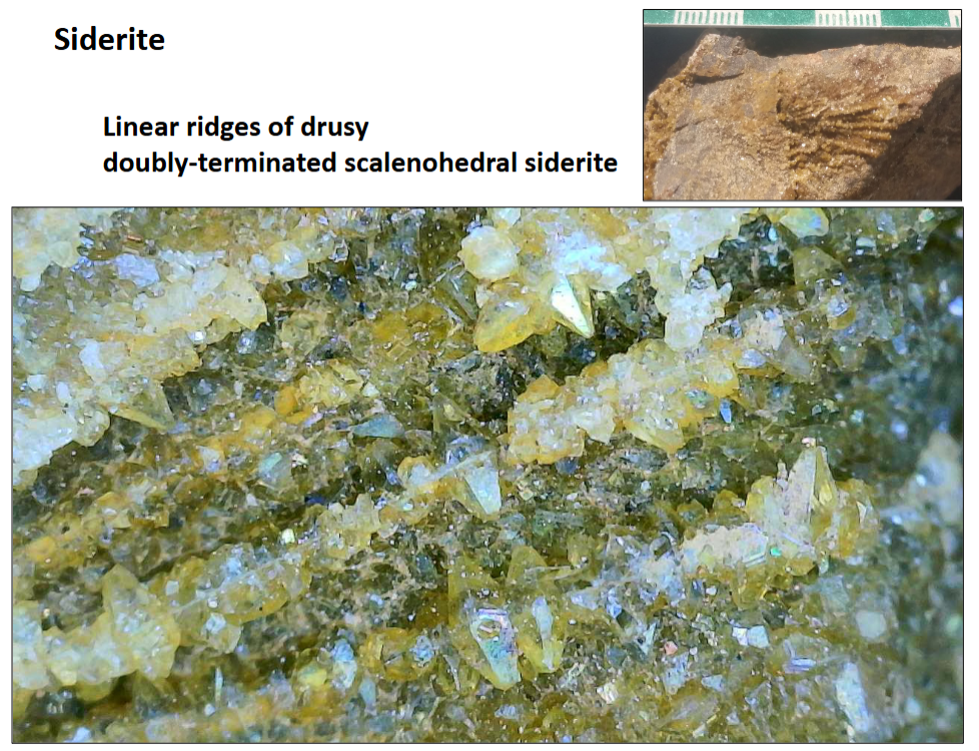
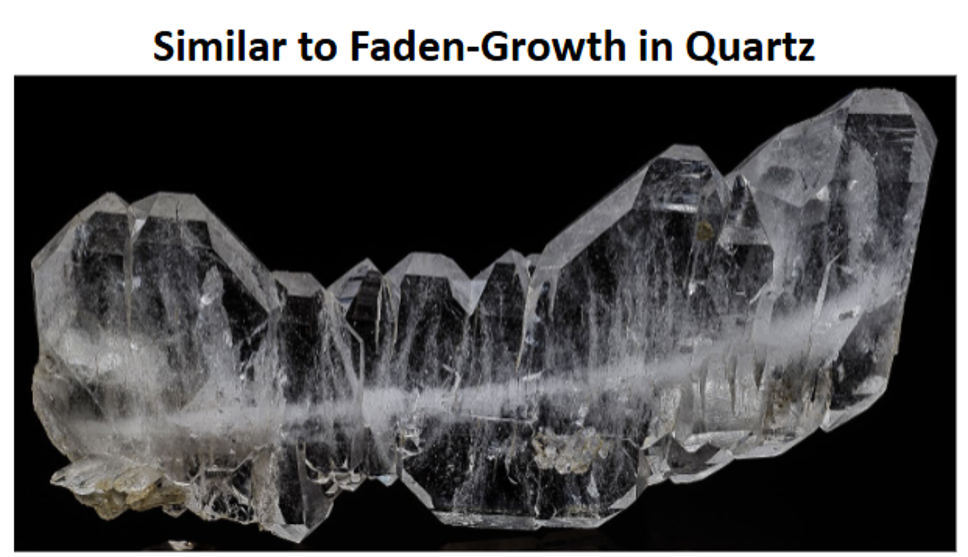
He said the photos above and below show a white linear growth which seems similar to the “threads” which occur in Faden quartz. “Faden” he said, is German for “thread” which describes the white lines running through the crystals shown above and below. Based on the recent work of Ukar and others (2025) (see reference list at the end) on the formation of faden quartz, Jake believes that the siderite ridges grew as the vug that contains them slowly opened, and the scalenohedral siderite crystals grew symmetrically outward from the central faden line.
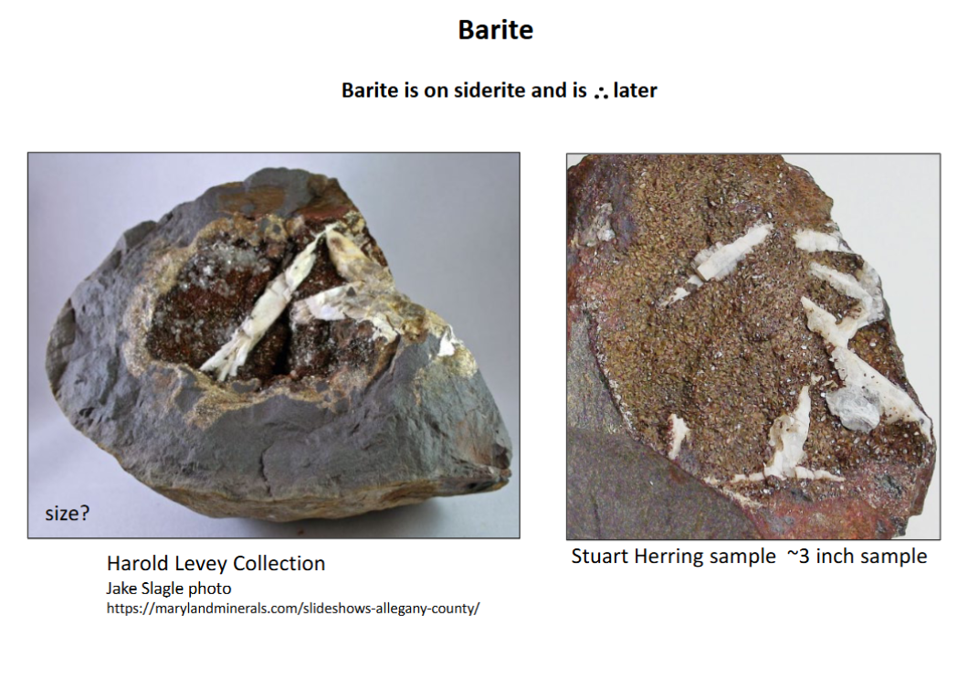
Barite Found in the Fire Clay Siderite Nodules
The white barite minerals are always found having grown on top of, and thus formed later than, the siderite shown in the photos below.
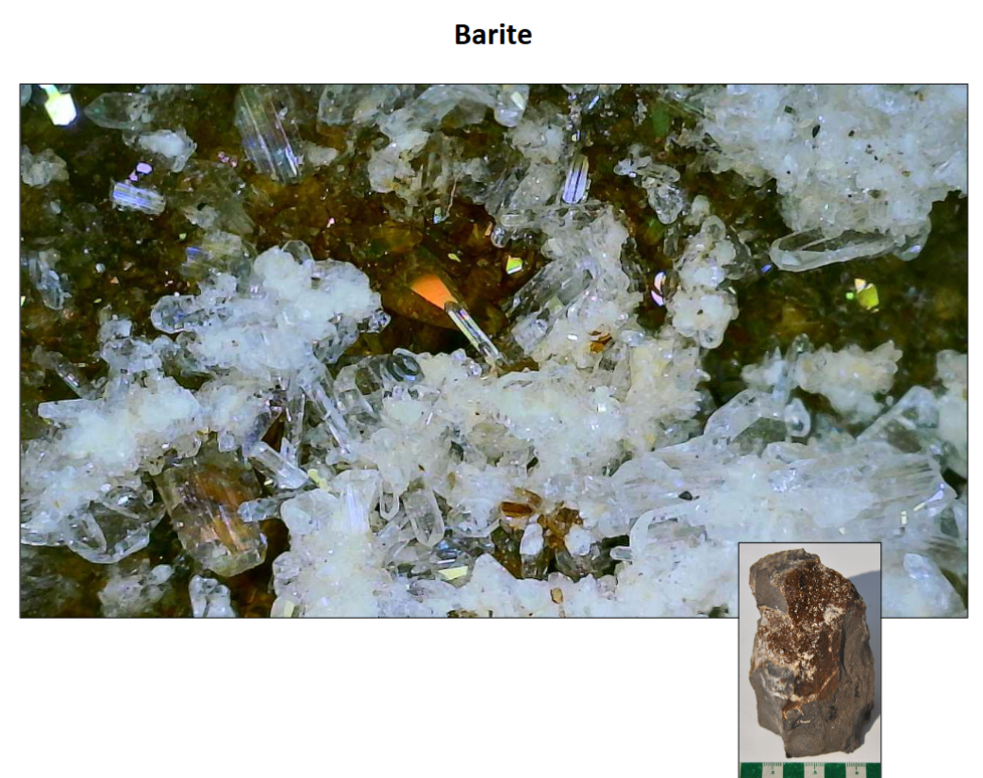
Below is another example of the barite (white) crystal growing on the edge of a siderite (orange) crystal.
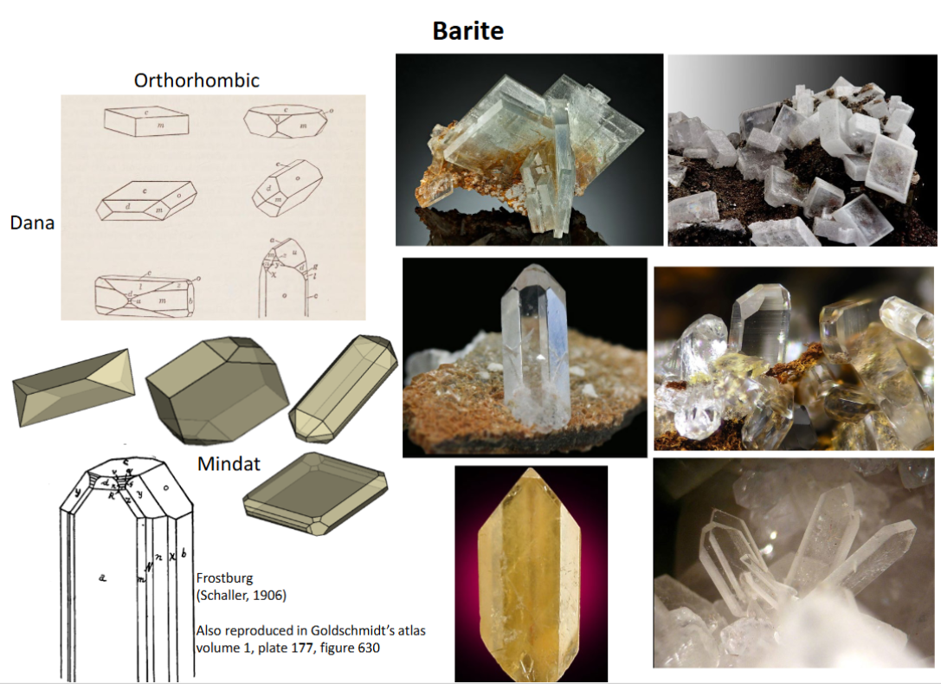
Blocky or tabular barite crystals (top 2 photos below) are the common forms found around the world, and in Jake’s experience come from higher-temperature occurrences such as the famous Meikle gold mine located in the Bootstrap Mining District of Elko County, Nevada.
The Frostburg site sometimes yields columnar, prismatic crystals. Their habits have wide varieties ranging from blocky crystals to feathery terminations, to radiating clusters, to “picket fence” crystals. Below are examples of some of the interesting forms in which barite crystals are found.
Millerite, a Rare Phosphate Mineral
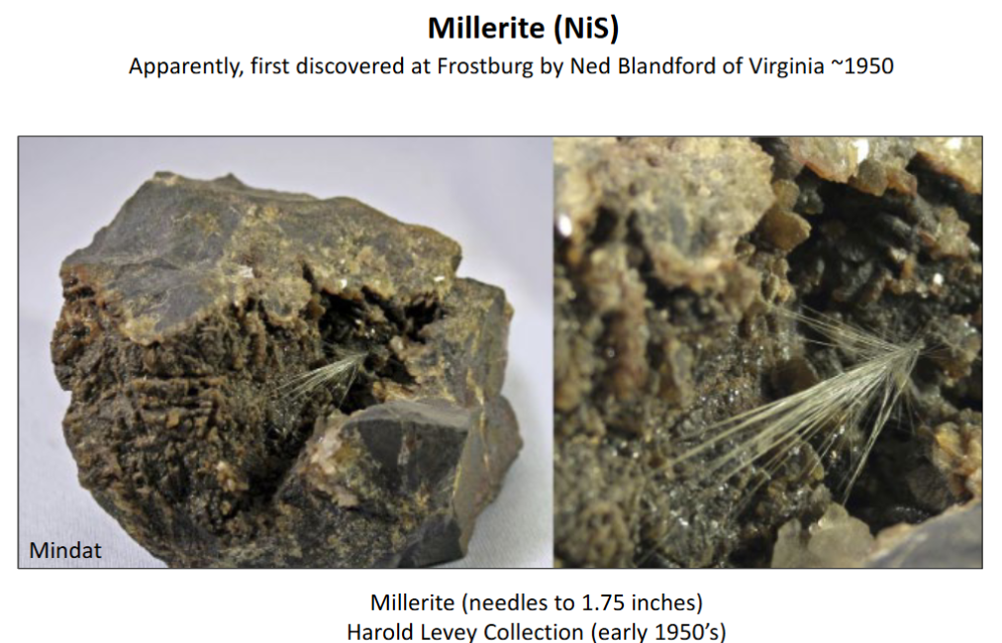
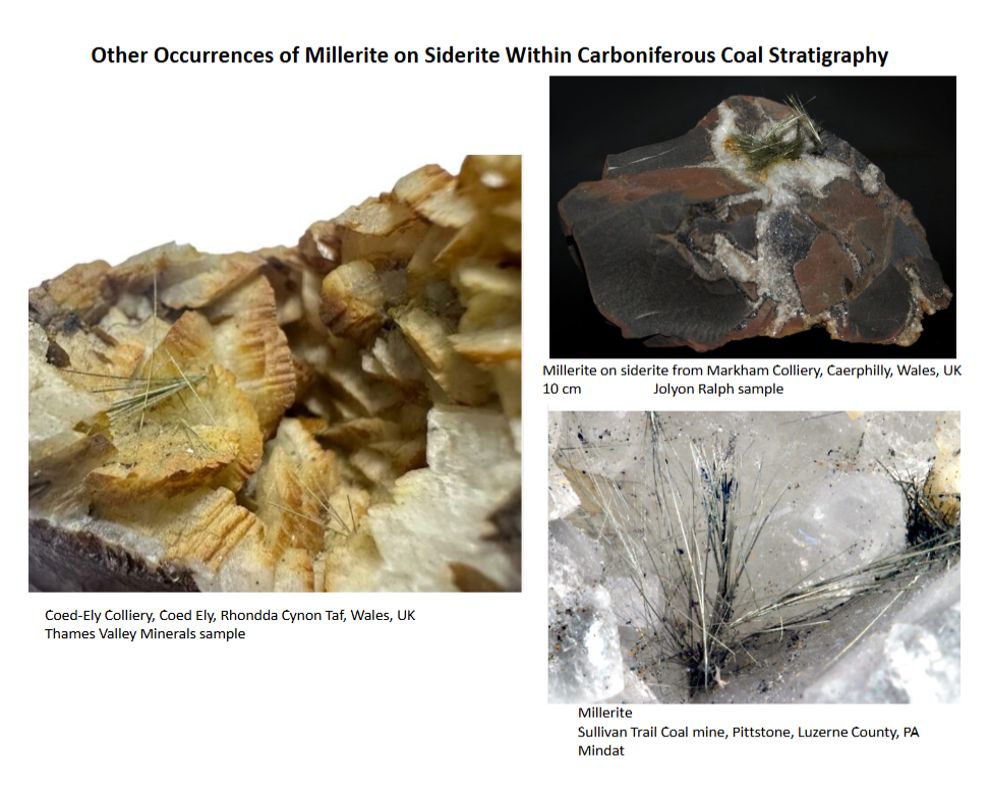
Millerite was apparently first found by collector Ned Blanford around 1950. Photos show it having grown on top of siderite crystals. So, like barite, it had to have formed after the siderite. Jake said he and his colleagues never found any millerite despite their bashing open hundreds of nodules. Elsewhere, finding millerite with siderite near coal is not unusual in Wales in the U.K. and in Luzerne County, Pennsylvania.
Jake reported he has also seen some marcasite. Other collectors have reported finding galena and sphalerite at the Frostburg region. But not having found any himself, he cannot vouch for that. He and his colleagues found only siderite and barite, no millerite.
The millerite yellow spray crystal had grown in the rock’s protective vug. The two photos are of the same brown rock, just with different sizing of focus. But it is the same rock and millerite crystal. The relative safety of the vug may speak to the issue of why it is sometimes difficult to find millerite crystals.
Formation of the Siderite Nodules
Jake offered a descriptive model of how the nodules may have formed. Siderite nodules occur in carbon-rich sedimentary rocks and metals such as barium and nickel gather in organic-rich sediments. As the sediments lithified, organic acids from the overlying material acidified the soil beneath, forming kaolinite, beginning about 275 million years ago. Slightly acidic, reduced groundwater carried iron in its ferrous state, and siderite precipitated as the iron reacted with carbon dioxide, probably from organic matter. The lack of pyrite or marcasite suggests little hydrogen sulfide was present.
Later, sulfate from more oxidized water mixed with the barium-bearing water and precipitated barite, and a little hydrogen sulfide may later have formed minor sulfides. Jake offered a PDF of the Journal of Structural Geology paper to anyone who contacts him through the club.
If collectors received permission from the property owners and visited Frostburg site today as Jake did, the photo below shows the likely collecting location. The Number 6 Pit seems to be the area most actively collected from today.
Regional Geology and the Frostburg Number 6 Pit
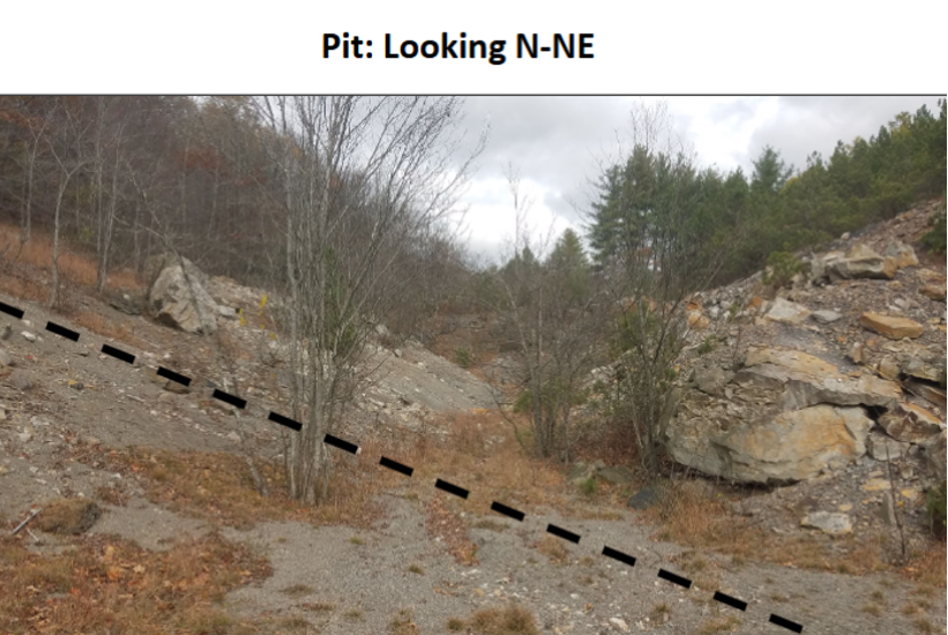
Western Maryland’s rocks were folded into synclines and anticlines by a compressional continental collision of the Alleghany Orogeny shortly before the Atlantic Ocean began to open about 190 million years ago. Today Frostburg sits in the axis of a syncline. The rocks dip east-southeast under the town and reappear on Piney Mountain by Interstate 68. The favorable clay horizon is present only on the west side. It was worked in open pits along about six kilometers on the east side of Big Savage Mountain in underground tunnels that followed the dipping bed.
The collecting site is the Frostburg Number 6 Pit, a few hundred yards north of old Route 40. It opened in 1906 and probably operated until the early 1950s. Today it is overgrown and the old underground portal is now the site of an auto repair shop. Baltimore collector Harold Levy brought the locality wider attention in a 1953 article in Rocks & Minerals. Jake emphasized that most of the area is private property. So visitors will need to gain permission before stepping onto the grounds.
Jake noted that the Pittsburg Carnegie Museum of Natural History has recently been conducting geological research of the Mount Savage clay. Below is a photo of the heat-resistant bricks that became so essential for the Pittsburg steel blast furnaces.
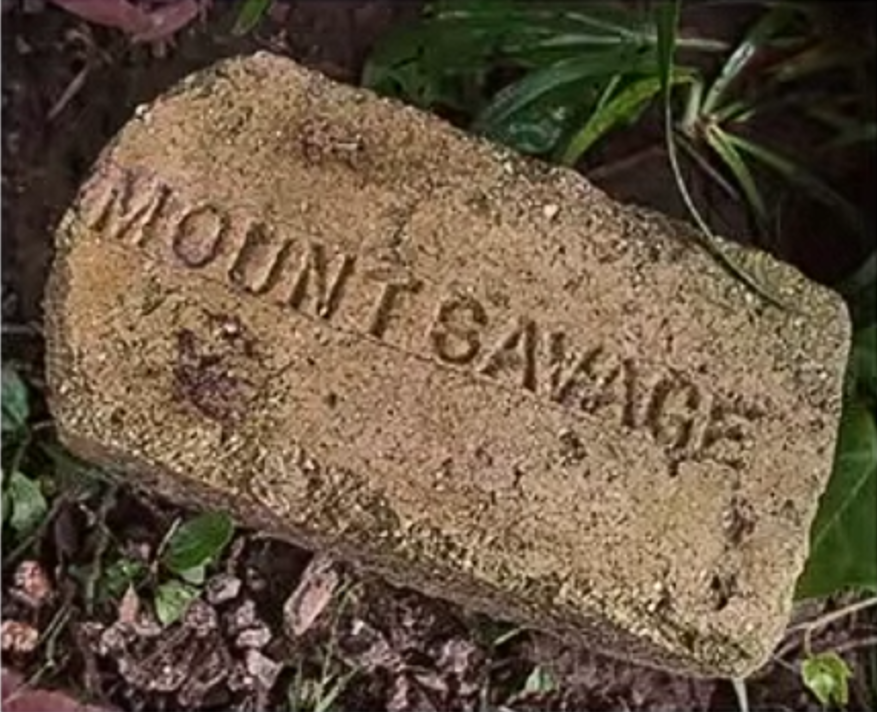
For readers interested in doing any follow-up research, Jake provided the following:
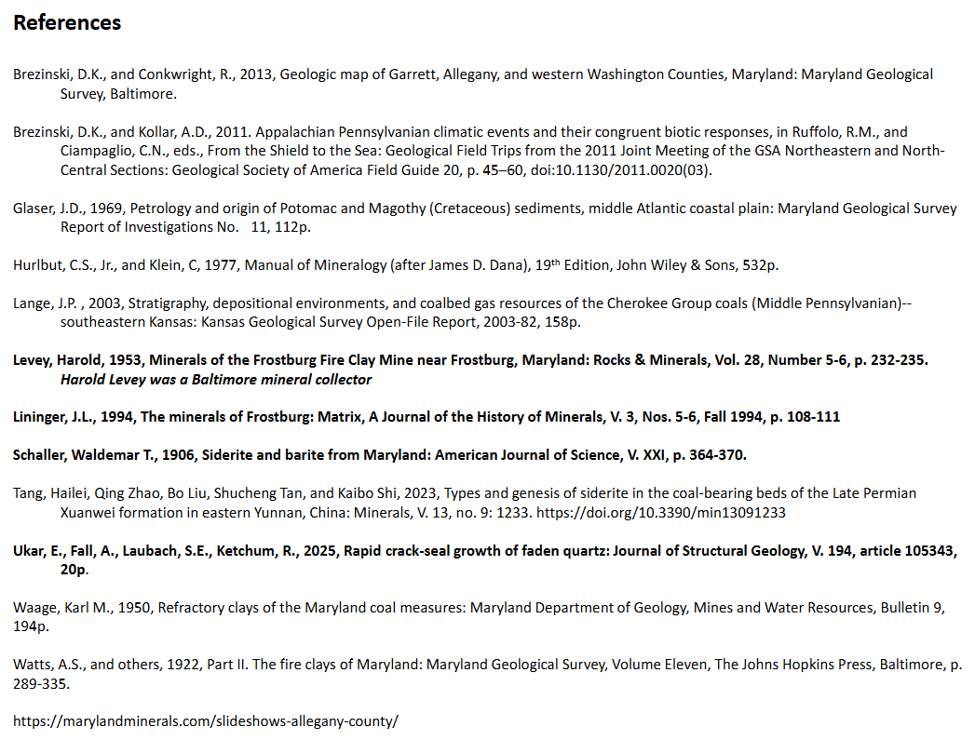
Jake concluded his presentation by thanking MSDC for hosting his talk and he invited questions from his audience.
Questions and Answers
With appreciative applause from the audience, President Dan Teich thanked Jake and said he found it fascinating that the research continues. Jake said the Carnegie work might also involve ongoing university research, but that was not yet clear. Dan wondered: Is millerite simply in a spot not yet found? Jake said the millerite may come from one small zone mined in the early 1950s.
Jake again added that the land is private; a worker at the auto repair shop said collectors could walk around, but Jake advised getting permission from a local person and noted collecting is at one’s own risk.
Kenny Reynolds noted the barite samples Jake showed were particularly sparkly crystals. Jake said such clarity is unusual in barite. Steve Stuart noted that Mindat’s page does not mention Mount Savage or the clay pits which Jake also confirmed.
When asked about millerite from Lancaster, Pennsylvania, Jake said the Gap Nickel Mine there is geologically very different, an older igneous and metamorphic setting.
In response to another question about a possible site for finding millerite, the Halls’ Gap rockhound collecting site in Kentucky, Jake noted it is similar to the Frostburg geology in that it is a sedimentary geologic formation.
With no further questions, Dan again thanked Jake for his excellent presentation and thanked all for coming. He also encouraged everyone to keep in mind the upcoming Norther Virginia Mineral Club’s annual gem and mineral show at George Mason University the weekend of November 21-22. If anyone wants to donate minerals to MSDC to send Dan an email. He hoped everyone would enjoy the show and stop by and visit with MSDC members at or table(s).
Readers: We remind our readers to check out the video of Jake’s YouTube presentation by clicking on the link HERE.