
June Program Report: "The Winston Diamonds and Other Recent Highlights at the Smithsonian," by Dr. Gabriela Farfan
Synopsis by Andy Thompson, MSDC Secretary
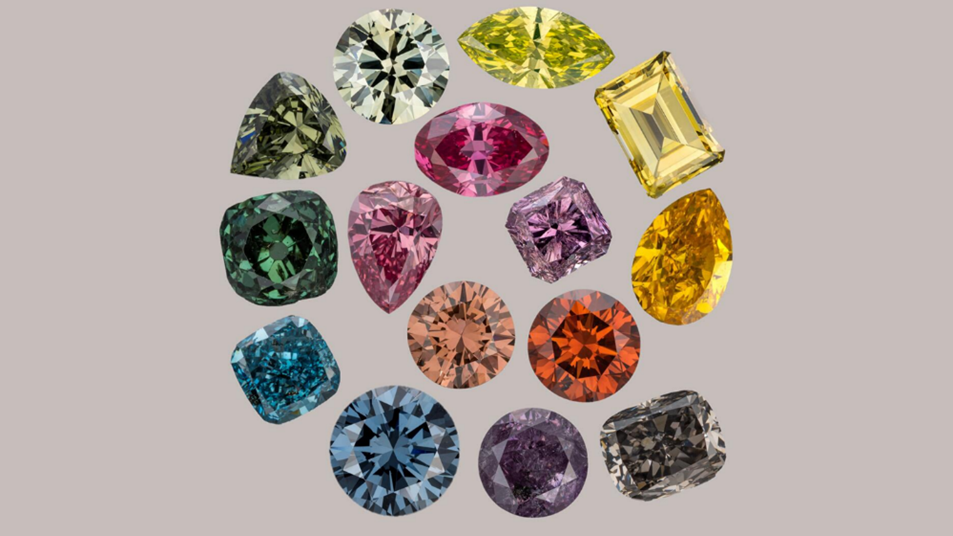
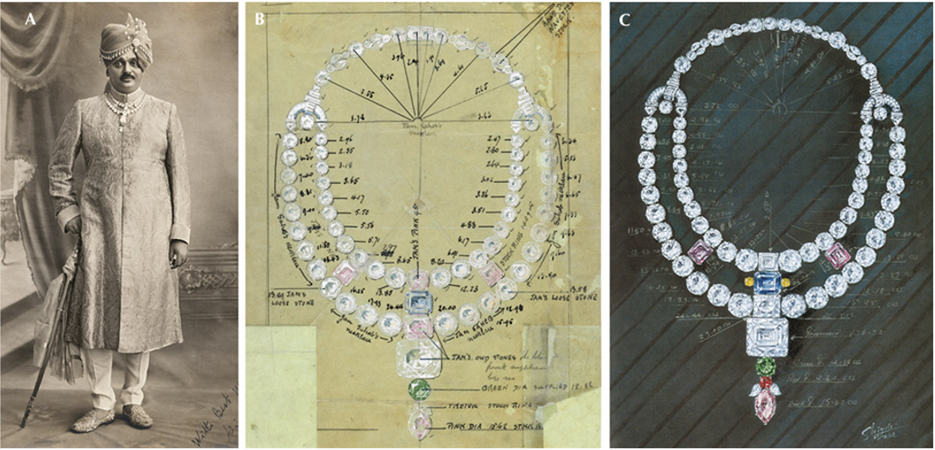
The Winston Collection totals 118 stones. Forty of the most impressive are now on exhibit in the Winston Gallery displaying a radiant rainbow of colors. The Winston Fancy Red is in the center as shown in the images below.
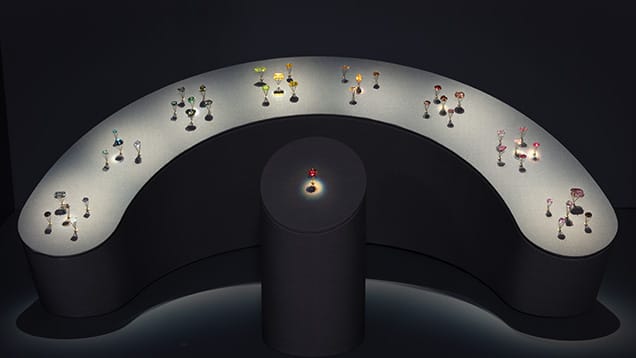
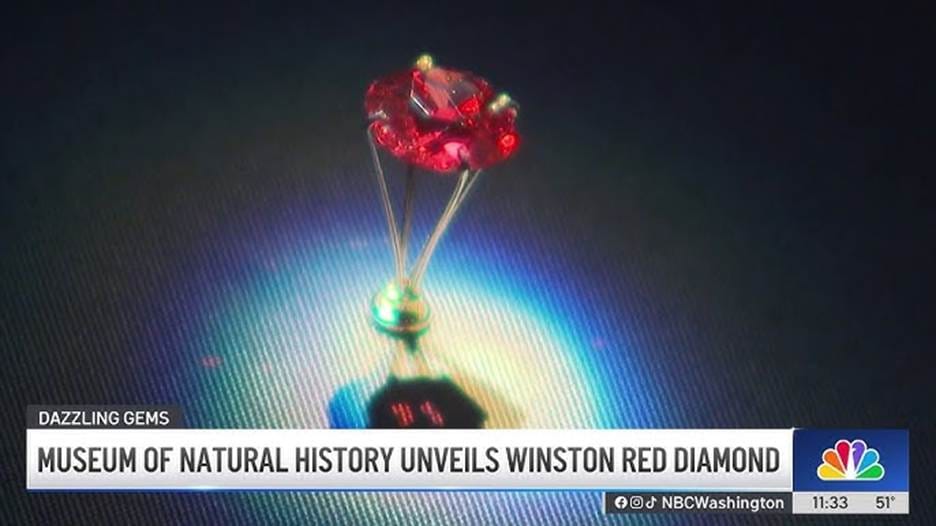
On June 4, Dr. Gabriela Farfan, the Coralyn W. Whitney Curator of Gems and Minerals at the Smithsonian’s National Museum of Natural History (NMNH), held her MSDC Zoom audience spellbound.
First, she explained the importance of the Smithsonian’s new Winston Color Diamond Exhibit and how it came to be. Then she shared findings of a study she and an international team conducted of the Winston Fancy Red Diamond, the first-scientific and historical study of this extraordinary stone. Lastly, in addition to the fancy diamond exhibit, Gabriela showed her audience photos and the stories behind several recent new gem and mineral acquisitions made by the National Museum of Natural History (NMNH), also worthy of a visit.
All three of these stories had their own urgency:
1) The Color Diamond exhibit at the NMNH, after two years of planning and preparation, had just opened on April 1. Gabriela encouraged each member of her MSDC Zoom audience to come explore the new exhibit;
2) The team’s scientific research findings were to be published on June 6 in the Spring volume of Gems & Gemology, 2025 Volume 61; and
3) The spectacular new mineral acquisitions whose photos she shared were going on display in the gem exhibit area and were worth visitors’ seeking then out.
The article was published in “Gem & Gemology, Spring 2025” as an “open source” document. The entire publication, including the article, may be found here. The research team Gabriela led included Ulricka F.S. D’Haenens Johansson, Stephanie Persaud, Eloise Gaillou, Russell C. Feather II, W. Henry Towbin and Henry C. Jones.
Readers, the purpose of this Program Report is to share with those MSDC members who missed Gabriela’s talk highlights of the above three stories. The links provided above will take you directly to the publication of her team’s research on the Winston red diamond. Importantly, the study was a collaboration between the Smithsonian’s Department of Mineral Sciences, the GIA, and the Paris School of Mines.
As an encouragement for our Mineral Minutes readers to pursue all of this marvelous information, here are a few highlights from each of the three main topics Gabriela covered in her presentation.
The Winston Fancy Color Diamond Collection
Gabriela encouraged everyone to come to the NMNH to see this spectacular exhibit.
The NMNH administrators and many departments worked hard together for two years to bring this collection to the public.
Before speaking about the significance of the Winston colored diamond collection, Gabriela provided a context for understanding what makes even common white diamonds important. She said many younger mineral collectors, herself once included, have often paid little attention to diamonds. After all, as a crystal composed essentially of only one element, carbon, a diamond can appear to be not only monochromatic but uninteresting. So, some ask: “what’s the big woof?”
She noted that many people are familiar with the basic criteria for evaluating diamonds, the well-known 4 C's: color, cut, clarity and carats. They also know that clear crystals are appreciated more than cloudy ones. In contrast, she then drilled down on the dynamics within the diamond’s crystal structure. Specific tiny inclusions and oddities in the structure itself is what brings color to the surface.
The term “fancy,” she said, is a technical term reserved for diamonds which have a vibrant and unique color.
Here are some of the specific factors she cited that explain the causes of color in diamonds and underscore the importance of the new Winston Fancy Color Diamond exhibit.
· Yellow, the most frequent color, is caused by the presence of tiny amounts of nitrogen atoms within the tight crystal structure of the carbon diamond. Overwhelmingly pale specimens are considered to be of lower value by diamond collectors.
· Deep yellow is extremely rare and caused by more numerous nitrogen atoms.
· Blue, as in the Hope diamond, is due to trace amounts of boron (a few parts per million) that replaced some of carbon atoms in the crystal lattice.
· Green and brown colors are caused by a vacancy in the lattice network.
· Pink color is caused by a deformation in the lattice structure.
· Red, orange and purple colors are a puzzle because too few are available to researchers to study.
Gabriela also told the impressive story of the origin of the Winston diamond collection across two generations. Harry Winston, a New York jeweler, is famously known in part for his having owned and donated the Hope diamond to the Smithsonian in 1958. Harry also donated a number of beautiful colored diamonds. Later, his young adult son Ronald left behind his own career with the chemistry of rocket propulsion and followed in his father’s footsteps.
For the next six decades Ronald honored his father’s memory by carrying forward and expanding his father’s jewelry business, the fancy colored diamond collection, and the Winston philanthropy.
In 1997 Ronald funded the popular Winston Gallery which is part of the Smithsonian’s Hall of Geology, Gems and Minerals. Over those decades, Ronald had never seen all his father’s earlier donations. By 2023, the Winston family had donated 40 fancy colored diamonds ranging in size from 0.40 to 9.49 carats. Their colors ranged from deep teal to soft peach.
The centerpiece of this collection is the extraordinary 2.33 carat "Winston Red" diamond, considered one of the rarest and most exquisite red diamonds in the world. The collection is currently on display in the Winston Gallery, housed within the Janet Annenberg Hooker Hall of Geology, Gems, and Minerals at the National Museum of Natural History.
Once the decision was made to exhibit the fancy diamonds, the careful preparation took two years. It was not until the time of his 2025 visit that Ronald saw for the first time, all 118 of those extraordinary donations of diamonds.
The centerpiece of the exhibit is the Winston Red diamond, the research on which Gabriela then described.
The Research Study of the Winston Red
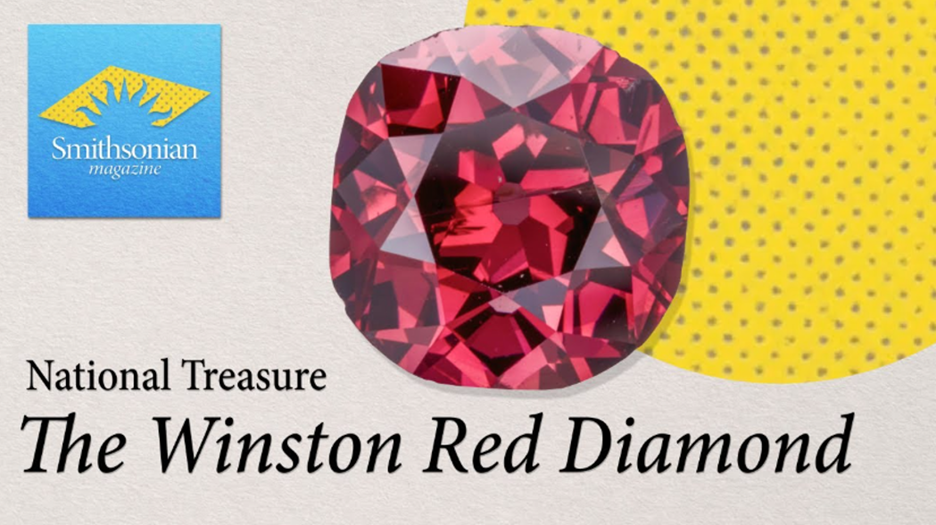
When Gabriela presented to MSDC on June 4, the report in Gems & Gemology had not yet been published. As a result, some of the scientific findings were under an embargo. But she could share the following information.
· This study of the Winston Red diamond was the first ever in the gem’s history.
· The study was a unique collaboration between the Smithsonian, GIA, and Paris School of Mines, with eight experts who authored the report, with Gabriela as the lead.
· Between these institutions and researchers, they formed their own temporary diamond lab at the Smithsonian with borrowed equipment from the participants.
· The Winston Fancy Red, at 2.33 carats, is the 5th largest red diamond in the world and the only one on public display, now at NMNH.
· How rare are fancy red diamonds? Gabriela, who has been interested in the Winston Fancy Red for the past 7 years, calculated that of every 25 million diamonds that have been discovered, the odds are that only one has been a fancy red diamond.
· The Winston Red “has no other modifying colors like pink, brown or purple. It is the purest version of red that you are going to find,” Gabriela noted.
The team also researched the history of the Winston Red. When it first arrived at the Smithsonian, the donor, Ronald Winston, shared that it came from India and had been purchased from the Maharaja of Jamnagar, who is wearing a diamond necklace, shown below in the image on the left. The image in the middle is an illustration of the necklace without the Winston Red at the bottom. The third image (at right) includes the Winston Red at the bottom of the necklace.
Gabriella encouraged everyone to come to the museum to see the new exhibit which took more than two years to bring to fruition. With considerable pride she praised all the administrators and diverse departments of the NMNH which cooperated to bring this new collection to the public.
Recent Gem and Mineral Acquisitions
Gabriela concluded her presentation by showing several beautiful acquisitions that the Smithsonian made in 2024.
SPESSARTINE GARNET, NIGERIA
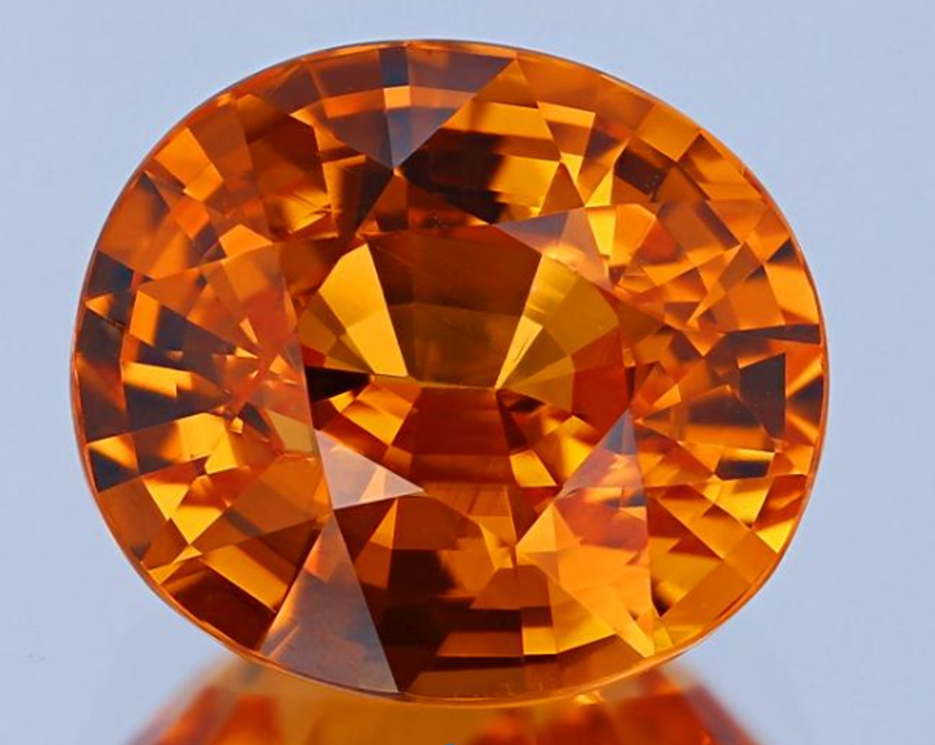
The first, above, was a beautiful brown Spessartine Garnet from Nigeria with a 30.5 carat weight.
Interested readers can find these and hundreds of additional specimens on the Smithsonian websites, such as the link here. The specimens can be looked up by clicking on their country of origin, name of the mineral, and others.
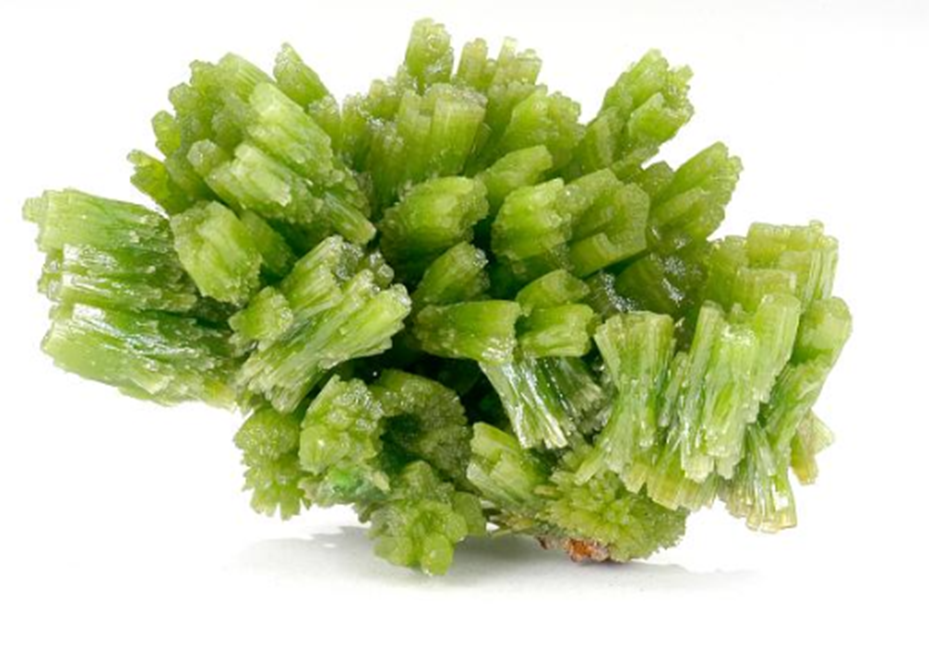
PYROMORPHITE, GUAMGXI, CHINA
A second new acquisition Gabriela described was a large green pyromorphite, shown below, from the Daoping Mine in Guang Xi, China. Its weight is not specified, but it is about the size of an adult’s head.
She showed additional newly acquired specimens, including a bicolored blue zoisite with a 12.85 carat weight and an intricate Brazilian carving called “The Trinity” for which photos were not immediately available for this article.
That sharing of recent gem and mineral acquisitions concluded the third part of Gabriela’s excellent presentation. She then addressed a wide range of questions from her Zoom audience, including issues of irradiation of the gems (mainly the very green), the paucity of red diamonds in the public record (only about 30; see the G&G article’s charts), the possible manufacture of pale yellow fancy diamonds but not of reds (due to the required very high pressure).
President Dan Teich thanked Gabriela for her excellent presentation and her audience provided their gratitude with sustained applause.
Following Dr. Farfan's presentation, GMU graduate and MSDC award recipient Sophia Campbell provided an introduction to her proposed research project, "The Case for Abandoning New Orleans: Geologic Implications of Man-made Interference in the Lower Mississippi Delta."