
October Talk: Siderite, Barite, and Millerite from the Mount Savage Clay, Frostburg, MD
by Laura Dwyer, MSDC Member
Minerals of the Mount Savage Clay
The Mount Savage clay is a three-meter-thick clay bed within Late Paleozoic (about 320 million years ago) coal-bearing stratigraphy that crosses western Maryland in the vicinity of Frostburg. Starting about 1840 and for more than 100 years, the clay, a “fire clay,” was used to make refractory bricks for the steel industry and other high-temperature furnace applications. The clay was mined in a series of open pits and underground workings for about 7 kilometers along the east flank of Big Savage Mountain, northwest of Frostburg.
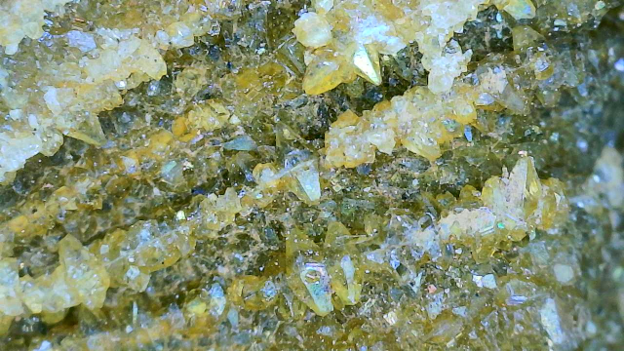
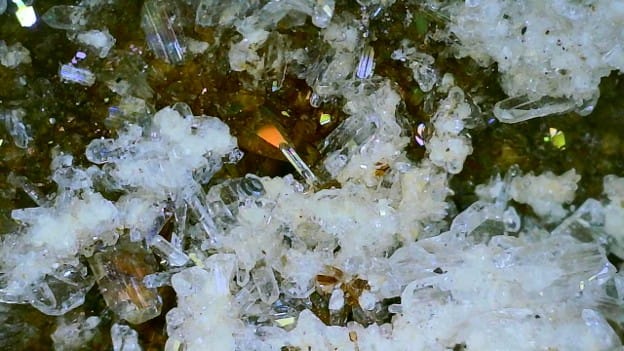
Nodules of dense, very fine-grained siderite occur in the clay in some areas. These nodules were detrimental to the mining process and were left on the mine waste dumps. These hard, septarian-like nodules are mostly <1 m in size and contain vugs and fractures lined with iridescent, drusy, yellow-green to brown ≤1 mm siderite crystals displaying scalenohedral, platy, and blocky pseudo-rhombic forms. White to clear barite occurs on the siderite and rare millerite has been found. The area has attracted mineral collectors since the late 1940s.
The clay bed is one of many “underclays” underlying coal in the Late Paleozoic Appalachian stratigraphy. These underclays are believed to represent soils below “coal swamps.” Kaolinite is the dominant clay mineral and indicates relatively acidic conditions. The siderite nodules likely formed during diagenesis and lithification of the sediments accompanying burial and regional compressional deformation during the Allegany Orogeny (mountain-building event) around 275 million years ago.
Jake Margolis Bio
Jake received a bachelor’s degree in geology from the University of Maryland, College Park. He also has a master’s in geology from the University of Washington and a doctorate in geology from the University of Oregon. His academic work focused on the geology and genesis of metallic mineral deposits, mainly gold deposits, a field known as economic geology.
Jake’s first job was with the USGS in Reston, but he spent about 30 years conducting mineral exploration in western North America, mainly for gold. He also has worked for several mining and mineral-exploration companies, mostly based in Reno, NV. Since 2020 he and his wife, Debbie, have lived in Bethesda, MD.