
October Program Report: “The Silver Mines of Lavrion, An Incredible and Diverse Mineral Wealth from Ancient Greece to Modern Times, Part 1,” by Fred Paraskevoudakis
Synopsis by Andy Thompson, MSDC Secretary
Laura Dwyer, MSDC member, introduced Professor Fred Paraskevoudakis (Paras) from Baltimore City Community College where he has taught microbiology, as well as biotechnology and environmental science, since 1992. Fred assisted Laura in providing the following overview of his presentation on the history of ancient Greek silver mining.
“Since ancient times and spanning more than 3,000 years, mining has taken place. It started with surface mining at the site of Thorikos, adjacent to Lavrion in Greece. More intensive mining began around 600 B.C. when the silver, lead, and zinc mines at Lavrion yielded not only enormous wealth over many centuries, but also a rich diversity of mineral species from that locality.”
Laura added that although Fred is professionally trained in the above-mentioned disciplines, his geological and mineralogical education began during his earlier years of collecting. Describing this passion, he told his MSDC audience: “It gets in your blood and you can’t get rid of it.”
During recent years, his geological understanding of these ancient silver mines of Greece has been enriched by multiple personal trips to the silver mines. Fred’s fluency in Greek has enabled him to have on-going discussions with local geologists and professional mineral collectors. Fred captured several of these in-depth explorations and discussions on video and shared them with his MSDC audience.
Readers: Those excellent videos and Fred’s extensive slides are not available for sharing in this program report. To tap into this wealth of field exploration and mineralogical knowledge, readers are encouraged to attend Fred’s upcoming “Part Two” presentation to MSDC on December 3.
The Geologic Structural Foundations of Greece
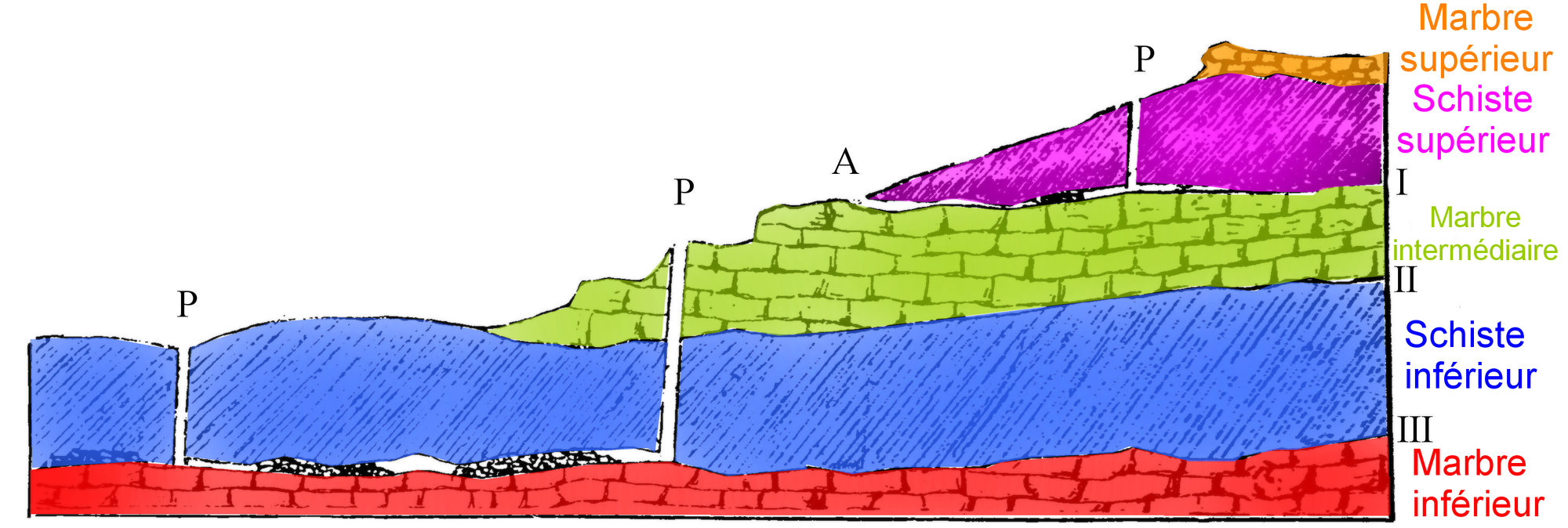
Fred introduced his audience to the geology of Greece by describing it as the result of the two major plates crashing together, with the heavier African plate subducting beneath the Eurasian plate. The resulting Attic-Cycladic Metamorphic Complex includes the Attic peninsula, the Lavrion region (tonight’s topic of its silver mines), and extends to some of the islands of the Cyclades archipelago. He described this complex as containing three contact zones with diverse ore deposits including a lot of lead, zinc, silver and an extraordinarily large number of minerals.
Ancient Silver Mining and how it Secured Greece’s Democratic Culture
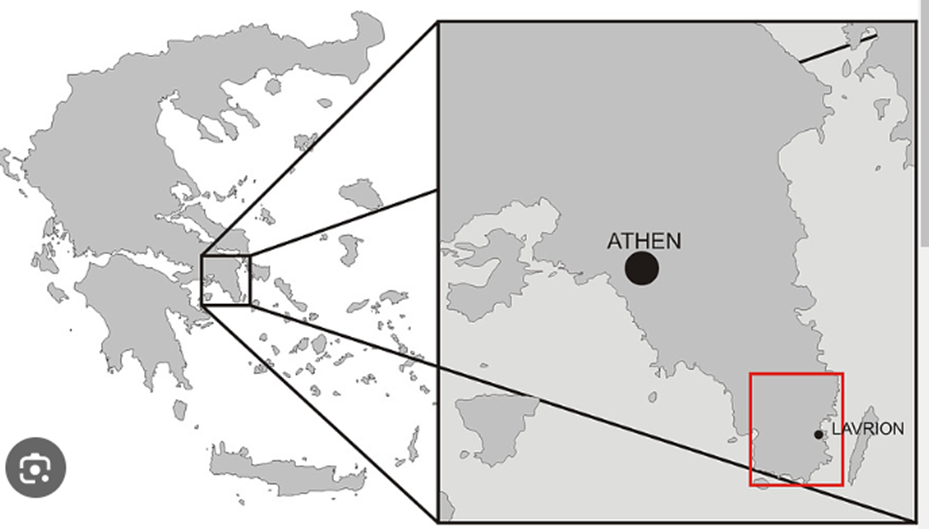
Fred said that mining in the Lavrion region of southern Greece began as far back as about 3200 BCE and was limited to sporadic surface digging. By about the 800s BCE, the mining had become more systematic and was supported by the brutal slavery of thousands working in the extensive underground mines. In 483, BCE the miners struck an extremely rich silver vein which was an economic boom to the nation. Its government, centered in Athens in greater Attica, was geographically close to the Lavrion mines and so remained directly under the government’s control.
Remember the story of Thermopylae and Xerxes’s victory over the brave 300 Greek Spartans? The Athenian politician and naval commander Themistocles convinced the Greek parliament to use the newfound silver financial bonanza for building 200 Trireme ships for what he believed was an inevitable upcoming decisive naval battle against the Persian empire. That showdown, known as the naval battle of Salamis in the Saronic Gulf, happened in 480 BC. At that time, the Persian empire under King Xerxes had superior armies and navies which earlier had successfully invaded Greek territories. However, the cunning Greeks prevailed in that battle and the Athenian economy, for subsequent centuries, thrived. Their naval victory changed the course of Western civilization.
How the Greeks Mined Their Silver
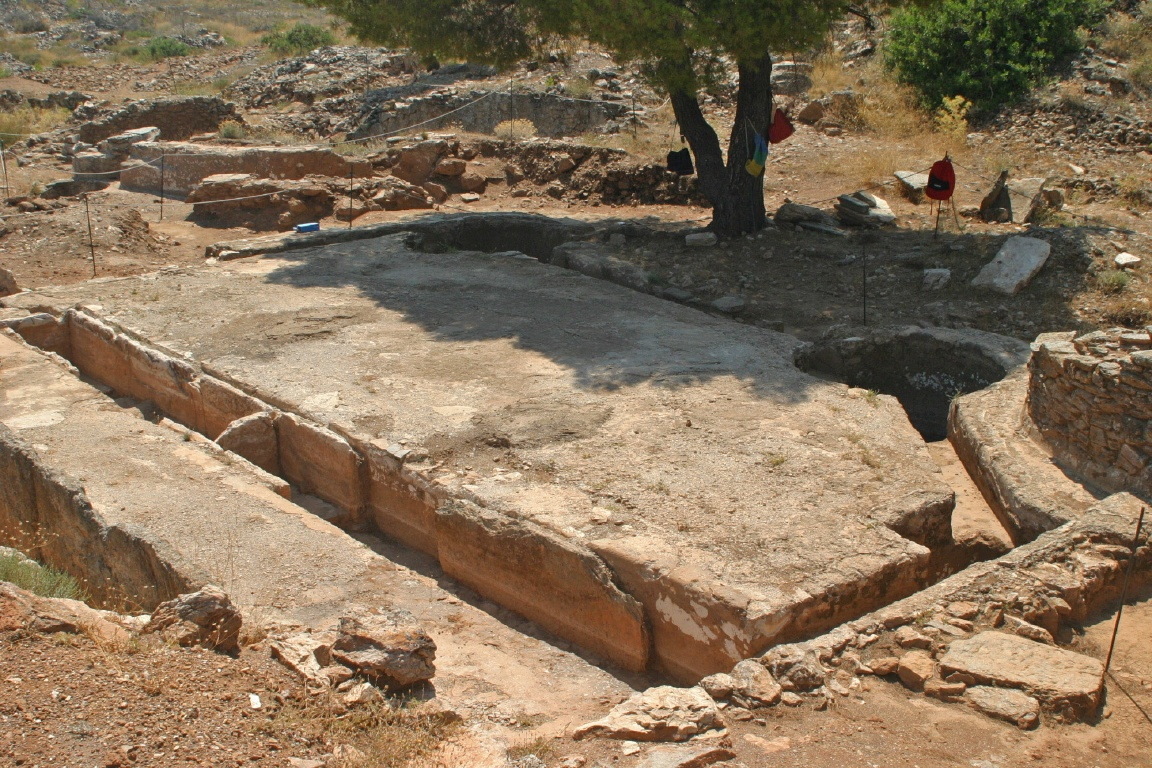
Fred then explained that the mining areas of Lavrion were remarkably well preserved over the last 2,000 years as evidenced by the photo at the top this column of one of the many washing tables where the silver ore was processed. In total, about 700 ancient mine shafts have been discovered along with about 200 ore processing stations.
The photo shows the narrow channels that brought water from storage cisterns to the scrubbing holes used for cleaning the minerals. The integrity of the processing sites was preserved because when the Athenian Greeks were eventually militarily defeated, silver mining and processing in effect ceased. Their processing sites were abandoned and left mostly intact.
Fred noted that the silver production process used at Lavrion in the fifth and later BCE centuries began with employing between 10,000 and 20,000 slaves to find and excavate the silver ore. They then crushed the ore to pebble size, washed it with the rainwater stored in cisterns. The Lavrion’s ore is argentiferous galena, a composite of lead and sulfur, and also silver. Because of its weight, this valuable ore sank to the bottom of the water trough separating it from waste rock. They then used high-temperature open ovens for successive burnings which further separated the silver from the lead and sulfur.
Exploring the Mineralogical Wonders of Lavrion
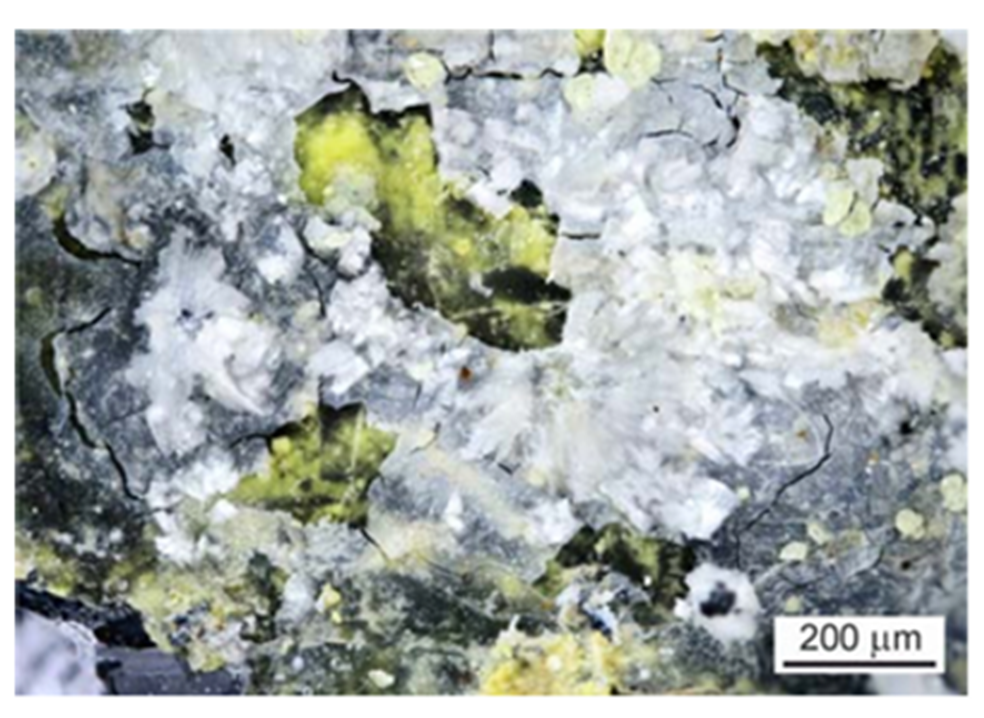
Aided by his relationships with local geologists and mine explorers, Fred has participated in many guided tours by local mine researchers and academics from other countries. Vasilis Stergiou, a particularly well-known local explorer, has led Fred and geologists through several of the Lavrion mines. Fred noted that Vasilis was instrumental in discovering several previously unknown minerals. The Lavrion region is acclaimed for its diversity of minerals, currently numbering over 670 species. Fred noted that one of those, Stergiouite, discovered in 2018, shown below, was named in Vasilis’ honor.
The fascinating short videos Fred made with his cell phone during the underground tours were extraordinarily educational. In one, an Australian geologist explained his reading of the rocks and how over geologic time, the several distinct formations interacted. The videos also showed what one explorer, referring to a colorful blue fluid dripping from the ceiling and accumulating on a ledge, said was evidence of a future deposit of a mineral which future explorers could discover.
Fred emphasized that many of the minerals formed over multiple generations of geological processes. His presentation culminated in his showing displays of beautiful minerals found in local Lavrion museums and also in Vasilis’ own personal collection.
At the conclusion of Fred’s stunningly beautiful presentation about Lavrion’s silver mines, he invited and received several questions from his audience. Kenny Reynolds, MSDC’s Vice President for Programs, concluded the evening by thanking Fred for his excellent presentation. Kenny reminded viewers to look forward to Fred’s “Part Two” presentation on December 3, where MSDC members and visitors can look forward to discovering more about the “Incredible and Diverse Wealth of the Silver Mines of Lavrion.”