
The Tip of the Iceberg and the Ghyben-Herzberg Principle
by Laura Dwyer, MSDC Member
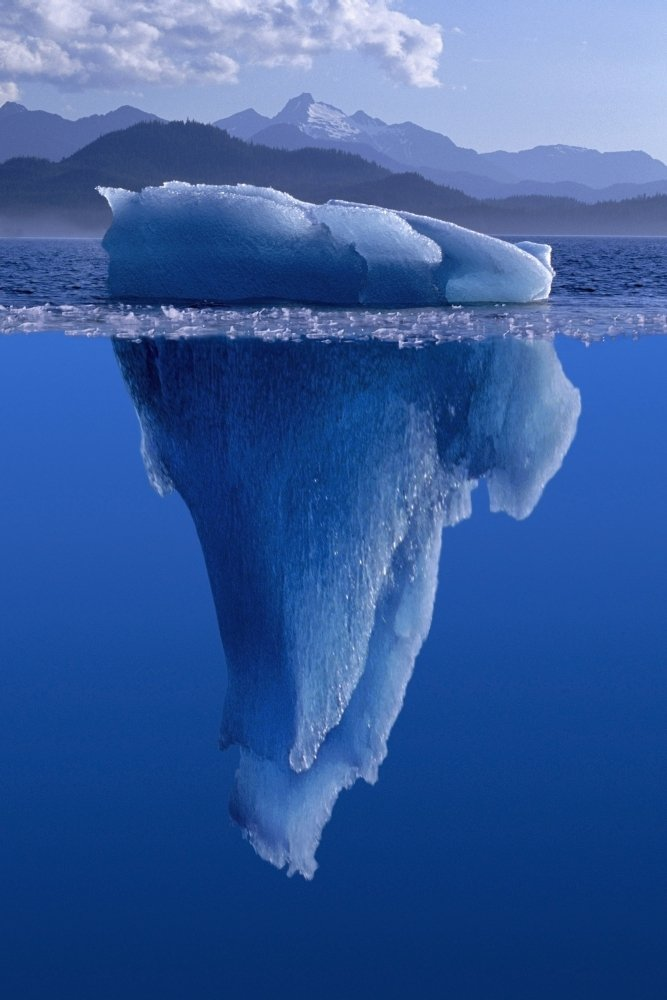
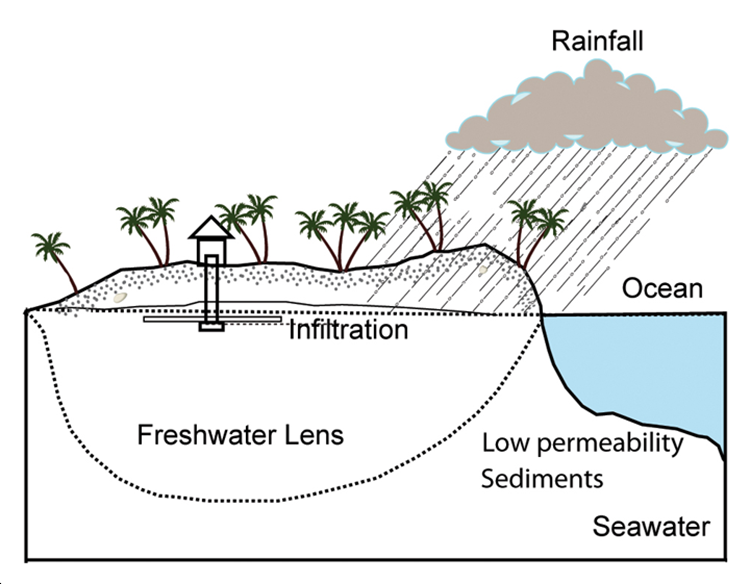
With our April presentation focused on crystals of the “mineral” ice, I was wondering, is one of the rock forms of this mineral the iceberg? As a hydrologist, it was fascinating to see that the typical cross section of an iceberg looked much like the shape of the fresh groundwater lens found on an island. So why does an iceberg look similar to fresh groundwater on an island? The Ghyben-Herzberg principle governs both!
The “tip of the iceberg” refers to the fact that most of an iceberg’s mass is below the ocean’s surface and only a relatively smaller part is visible above the water. The reason for this is that ice is less dense than saltwater and so it floats. Similarly, in island or coastal hydrology, since freshwater is less dense than saltwater, a fresh groundwater lens floats above the denser underlying saltwater.
The Ghyben-Hertzberg principle (or formula) shows that for every unit (i.e., meter or foot) of freshwater above sea level, there are approximately 40 units of freshwater below sea level.
Since we know that the density of freshwater is approximately 1.000 g/cm3 and the density of saltwater is approximately 1.025 g/cm3, we can show how the formula works, as follows:
The formula for the depth of freshwater below sea level, z, is:
z= height of freshwater table above sea level x ((freshwater density/(saltwater density - freshwater density))
z= height of freshwater table above sea level x ((1.000 g/cm3/(1.025 g/cm3 - 1.000 g/cm3))
z= height of freshwater table above sea level x (1.000 g/cm3/0.025 g/cm3)
z= height of freshwater table above sea level x 40
So if the freshwater table is 1 meter above sea level, the depth of freshwater below sea level, z, should be = 1 m x 40 = 40 m
Thus, we can say that for every meter of fresh groundwater above sea level, freshwater occurs to a depth of 40 meters below sea level.
The formula can also be used to calculate the depth of an iceberg below sea level, based on its height above it. The density of typical ice is approximately .920 g/cm3 and since seawater is 1.025 g/cm3, the difference between saltwater density and ice density is (1.025 - .920 =) .105 g/cm3. The ratio is .920/.105 = 8.76.
This means that for every meter of the iceberg that is visible above the sea surface, approximately 8.76 meters of ice lies below the surface. A 1 meter tall iceberg above + 8.76 m below = 9.76 m total height, of which 8.76/9.76 is below the surface. This is 89.75 per cent, which means that close to 90 per cent of the iceberg is below the ocean’s surface and approximately 10 per cent is visible above the surface.
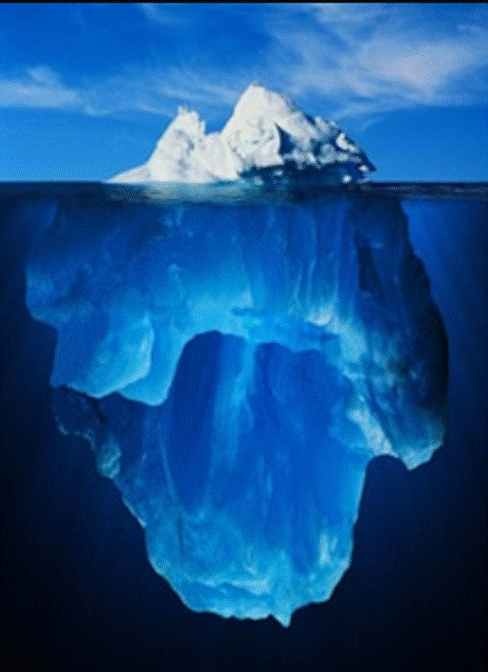
Now that you know how density governs these relationships, you can see how the cross sections of an iceberg at sea and an island’s freshwater lens look so similar.
Iceberg Orientation
Nearly every iceberg you see in a picture or diagram (including the images in this article) is probably floating the wrong way. As we have learned here, about 90% of an iceberg is below the surface and 10% above, which is partly why they can be so dangerous.
While most iceberg pictures get this part more or less correct, most of these icebergs will be floating vertically. In reality, a tall, thin iceberg will likely topple, so most icebergs end up floating on their side, not their tips, even though we rarely draw them this way.
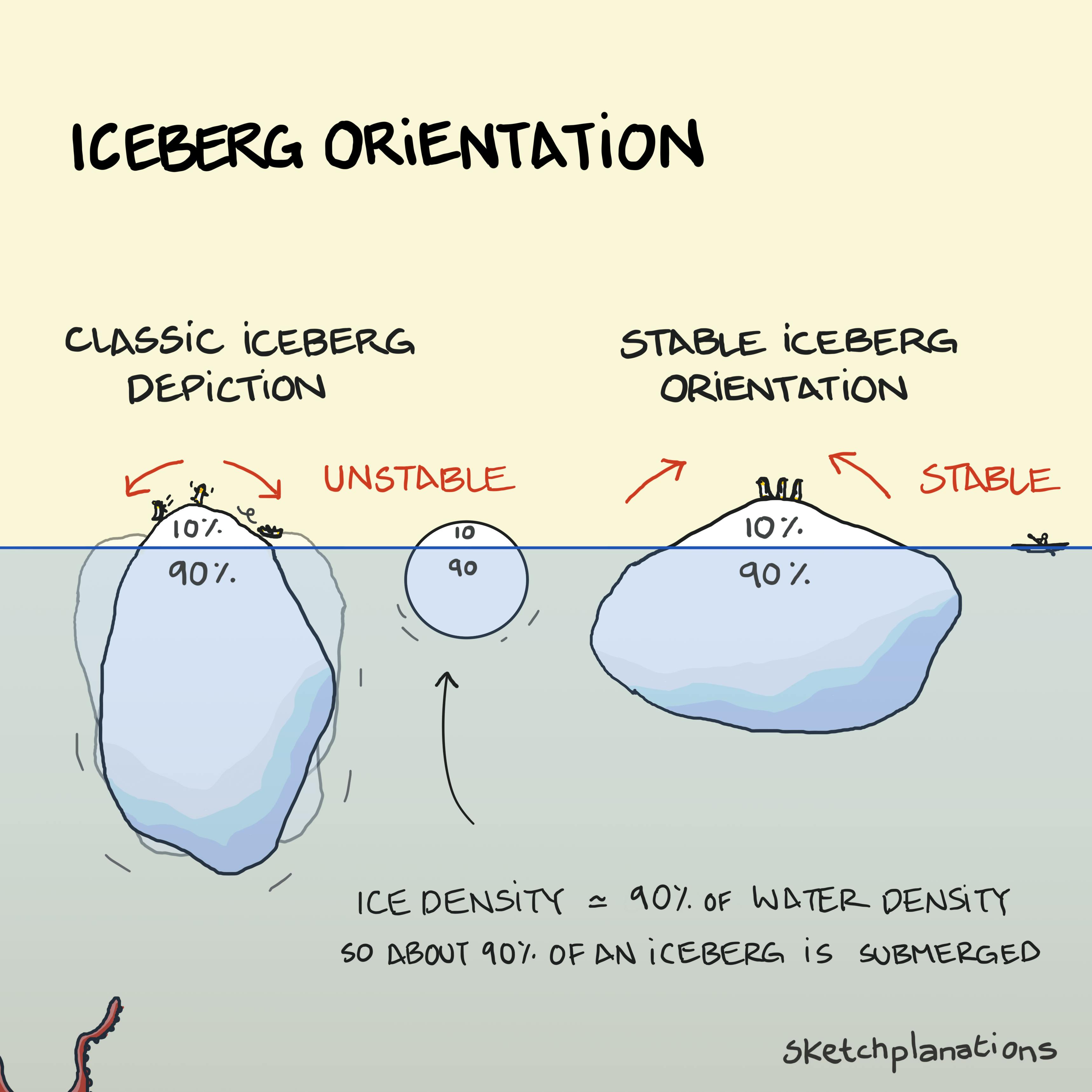
We may still want to draw our icebergs tall and deep to make our point, but now, at least, we can do so with the knowledge that they're not like the real ones.
Draw Your Own Iceberg and See How it will Float
If you want to see it yourself, Joshua Tauberer made a brilliant draw-an-iceberg-and-see-how-it-will-float game. Please give it a go and enjoy! This game will help the information sink in (sorry).