
Two Countries, Three States, Four Great Lakes, and Niagara Falls
by John Weidner, MSDC Treasurer
My high school chemistry teacher, when he was teaching in the center of Wisconsin, once told his students that the Niagara Escarpment ran through his back yard. One of his students went home and told his mother Niagara Falls ran through his teacher’s back yard.
No! No! It's the Niagara Escarpment, not Niagara Falls!
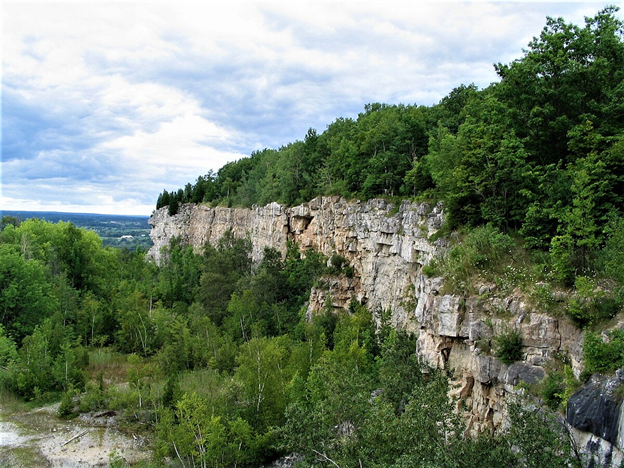
An escarpment is a steep slope or long cliff that forms due to faulting or erosion and separates two relatively level areas having different elevations. (”Wikipedia article: “escarpment”)
Everybody knows Niagara Falls. Not too many have heard of the Niagara Escarpment, although it is one of the larger geological formations in the country. It’s 450 miles long!
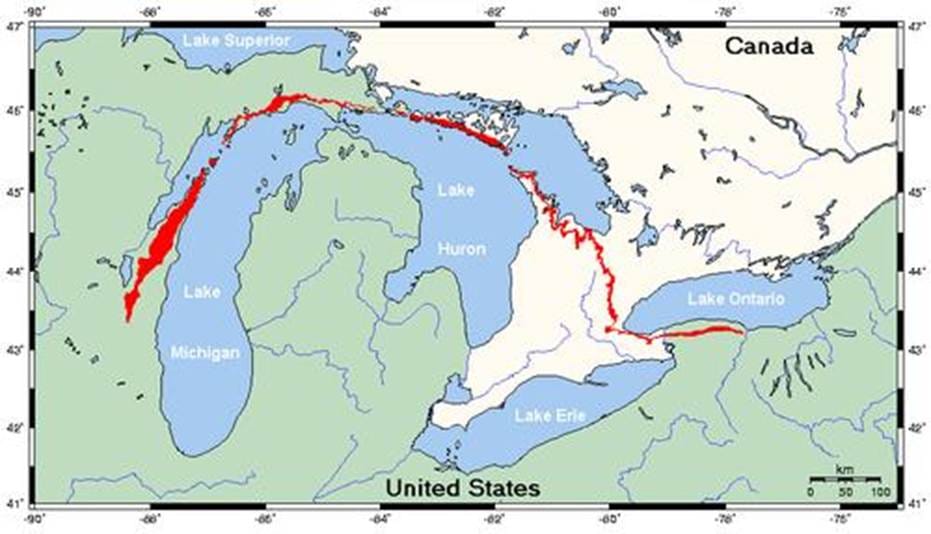
The escarpment is a ridge of dolomitic limestone that stretches from east of Niagara Falls, across the top of Lake Huron and down into the middle of Wisconsin. It’s best known in this country for two places: Niagara Falls, and the thumb of Wisconsin.
The limestone of the escarpment is dolostone [CaMg(CO3)2], a rock composed mainly of the mineral dolomite, which is calcite with significant magnesium in place of some of the calcium. Pure dolomite typically contains about 46% magnesium carbonate, a substantial amount not found in the calcite that makes up limestone. Dolostone is slightly harder than pure-calcite limestone [CaCO3]; dolomite has a Moh’s hardness of 3½ -4; calcite has a hardness of 3.
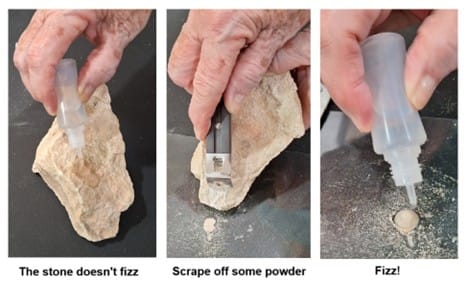
Dolomite is also significantly less chemically active than limestone. When a geologist (or one of my kids at the library rock club) drips acid on calcite limestone, it fizzes. When she or he drips acid on dolostone, there is no noticeable reaction. Scrape the dolostone to produce a little pile of powder, drip acid on the pile; it fizzes, but you must powder it to get the fizz.
Thus dolostone, being harder than limestone and less reactive, is less easily weathered (or eroded) from the rock faces in the area.
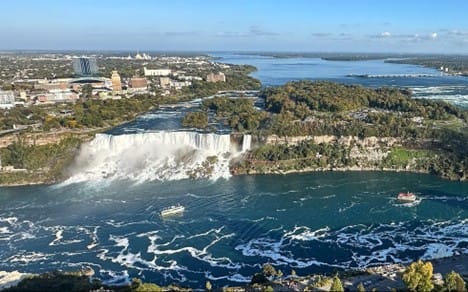
The Niagara Escarpment is key to the continued existence of Niagara Falls. The Niagara Escarpment dolostone is the top layer of Niagara Falls. The rock beneath it is a softer shale. Weathering forces are greatest at the crest of any waterfall. In a typical waterfall, that greater weathering force breaks down the waterfall from the top. A typical waterfall weathers into a shallower and shallower slope, ending as rapids. But at Niagara Falls, the softer shale underneath weathers out, undermining the dolostone. Eventually enormous slabs fall, but the top height of the falls does not change.
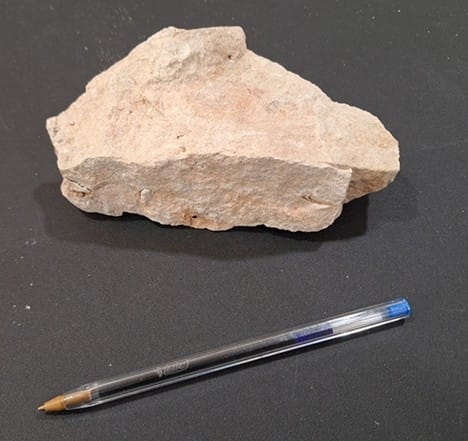
One would think that the area below the falls would eventually be covered with enormous slabs of dolomite. That might have been true in pristine North America, but in today’s world, where more rock, gravel, and dirt are moved by human activity than by natural erosion, humans have intervened at the falls.
By sheer coincidence, a little over fifty years ago, Susie & I stopped for the night in the city of Niagara Falls, NY, on the night they shut off the falls. We watched as they bulldozed an earthen levy into the river to stop the flow of the American Falls. Engineers and geologists inspected the falls, cleared out the fallen dolostone, and then, a couple weeks later, removed the levy. (They did not invite us back to see the reopening of the falls.)
My first personal involvement with the escarpment was when I was a kid in Wisconsin. Being a sedimentary rock, the Niagara dolostone splits into flattish slabs, ideal for building and being used as paving stones. My father got a load of the stone, called Lannon stone in Wisconsin, to build low garden walls and pave a patio and garden paths.
Then, last summer Susie & I spent several days on the “thumb” of Wisconsin, which includes the Niagara escarpment. Again, the harder, weathering-resistant rock explains that thumb. A softer rock would have weathered away and be underwater in Lake Michigan. Instead, this is there for our recreational pleasure.
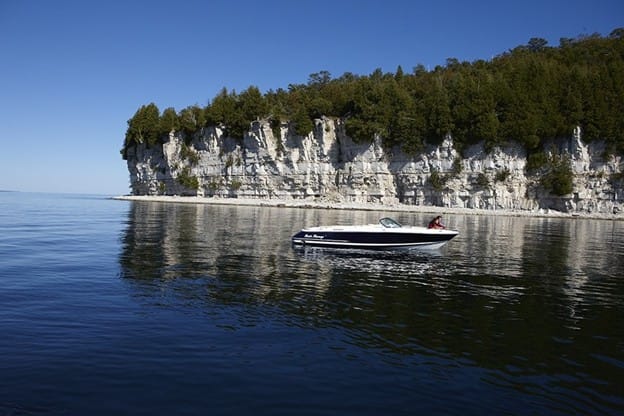
Wikipedia tells us that the escarpment formed as the shore of an Ordovician-Silurian epicontinental sea. That makes sense. Look at the map. It seems reasonable to picture it as the north shore of a large sea. But I can’t vouch for that personally. That happened 450 million years ago. I’m old, but not that old.
I’m guessing that most of you had not heard of the Niagara Escarpment before. Well, now you have, so now you can be just as annoying as I am. You have another topic for the geological lectures we all love to break into at dinner parties and other social gatherings.