
The World's Newest Mineral
by John Weidner, MSDC Treasurer
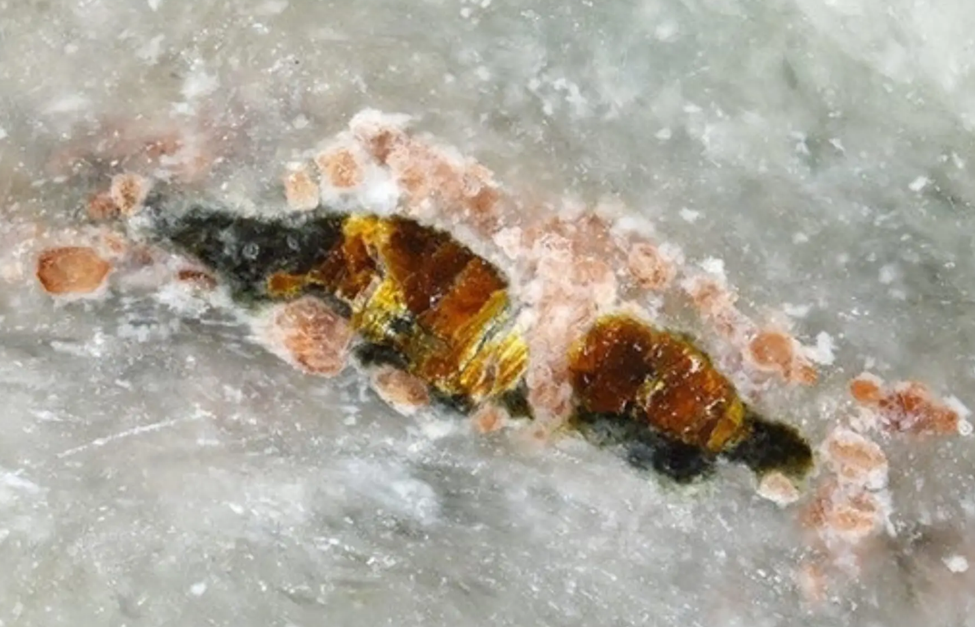
Happy New Year!
And what better way to celebrate the new year than with the world’s newest mineral, a task that is not as easy as it sounds.
Google "Newest Mineral." The AI response begins:
"There isn't one single "newest" mineral, as several are approved monthly by the International Mineralogical Association Commission on New Minerals and New Mineral Names..."
“Several are approved monthly!” A little research brought up the statement that 103 new minerals were approved in 2024. That’s almost two per week, which means if I were smart enough to find the newest approved mineral, there would have been at least three more approved before you read this. (Unless the approvers take off for the many end-of-the year holidays.)
One source I looked at listed wenqingite, ferroåkermanite, amaterasuite, and zhonghongite as being among the new minerals.
Wenqingite: But they taught me you can’t have a “q” without a “u” after it.
Mindat notes that wenqingite is the first mineral that contains both thiogermanate and thioarsenite, whatever those are.
Ferroåkermanite: with a funny little circle over the first “a.”
Mindat notes that ferroåkermanite is the name for the iron analog of åkermanite, which is of tremendous interest to anyone who knows anything about åkermanite.
Amaterasuite: This mineral was discovered hidden inside jadeite, Japan’s nationally designated stone. It was named after the Shinto sun goddess Amaterasu.
(Are we going to name the next mineral “professionalite?”)
Zhonghongite: This one gets my vote as the most fun to pronounce.
Cu29(As,Sb)12S33. But it’s not the newest mineral. It was discovered way back in 2023. Yesterday’s news!
And of these four, the only picture I could find is of amaterasuite (photo at the top of this column).
The Commission on New Minerals and New Mineral Names
Who says they get to decide what new things are minerals? Well, they say so. And the International Mineralogical Association says so, and for the most part, no one challenges their right to do so. And after all, someone has to do it.
Their rules complicate the search for the newest minerals, since, to quote from their website:
“The IMA Commission on New Minerals, Nomenclature and Classification publishes details of new minerals on its website for comparative purposes and as a service to mineralogists working on new mineral species." "The names of new approved minerals are considered confidential information until the authors have published descriptions or released information themselves.”
So even if I could find the newest mineral, I could describe it, but couldn’t tell you its name.
Well, then, how do you and I get that orange lump of stuff outside our back door officially recognized as “orangelumpite”?
No problem. (No Problem??) Just provide the following information to the commission, or least as much as applies:
· The name: Orangelumpite
· The chemical formula
· The crystal system, including space group and point group.
· Our names
· Where we found the orangelumpite
· Associated minerals
· How it formed
· Color, streak, luster, hardness, etc.
· Uniaxial or biaxial measurements
· Dispersion
· Pleochroism
· Reflectance values
· How the chemical data was obtained
· How the single crystal X-ray studies were carried out
· And more stuff I don’t understand well enough to be able to list it.
My conclusion from this list is that there is an AWFUL LOT of technical mineralogy I don’t understand. I should suggest that I will work to learn this during the new year. But I won’t. I am an amateur. I enjoy my amateur mineralogy. And I hope you enjoy yours.